
By the Coursel.Online Bureau of Political Analysis and Public Policy
WAMUNYORO, Kenya—In Kenyan statecraft, national holidays are rarely mere celebrations of civic heritage. They are choreographed displays of state power and political messaging.
On Mashujaa Day 2026, President William Ruto presided over the national parade at the Eldoret Kipchoge Keino Stadium in his native Uasin Gishu County. Flanked by military generals, cabinet barons, and visiting dignitaries, the head of state delivered an address steeped in economic self-congratulation, celebrating the rollout of his administration’s flagship infrastructure projects. Just twenty-four hours earlier, he had snipped the ceremonial ribbon at the Pioneer Affordable Housing project in Eldoret, holding up the multi-story concrete blocks as proof of his bottom-up economic transformation.
Yet, 300 miles to the east, tucked inside the misty foothills of Mount Kenya, a far more consequential political drama was unfolding in the village of Wamunyoro, Mathira constituency.
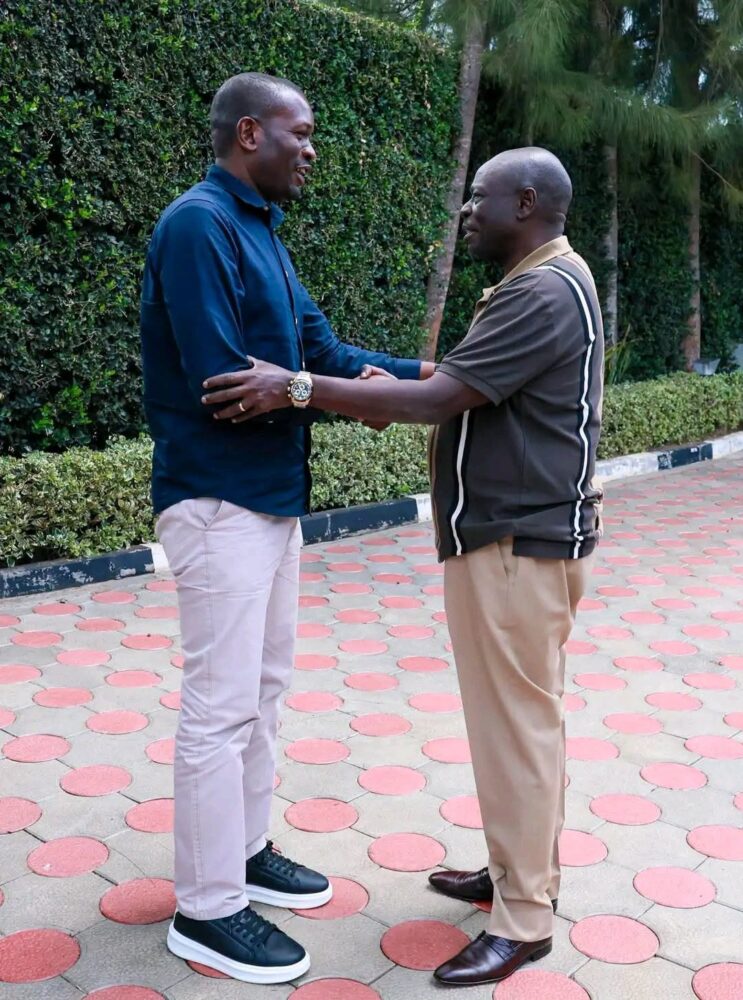
There, inside the private residence of impeached former Deputy President Rigathi Gachagua, an unscripted meeting took place that sent tremors through State House Nairobi. Gachagua’s guest was Edwin Watenya Sifuna—the charismatic Nairobi Senator, former Orange Democratic Movement (ODM) Secretary-General, and rising star of the country’s progressive opposition.
The optic of the two men sharing tea, deep in counsel, represented a breathtaking realignment of political gravity. Just eighteen months earlier, Sifuna had stood on the floor of the Senate and voted to impeach Gachagua, prosecuting a state-backed trial executed under the explicit instruction of the late opposition leader Raila Odinga, whose visceral disdain for Gachagua had long been an open secret in the capital.
Today, that animosity has dissolved into cold, unsentimental realpolitik. Gachagua, having survived political defenestration to emerge as Ruto’s boldest, most influential antagonist, has successfully wrested control of the populous Mount Kenya voting bloc from the ruling administration. Sifuna, meanwhile, has emerged as the most attractive national candidate of his generation, commanding widespread support across ethnic divides and dismantling the government’s leverage in western Kenya.
Their dialogue in Wamunyoro was not a social courtesy. It was the preliminary drafting of an electoral siege engine designed to make William Ruto a one-term president.
The 1992 Fallacy: Why Ruto’s Electoral Mathematics Fall Apart
Within State House corridors, ruling strategists have long operated on a historical comfort: the Daniel arap Moi precedent of 1992.
In Kenya’s first multiparty election, Moi retained the presidency with a mere 36.6% of the national vote. He survived because the opposition splintered along tribal fault lines: Kenneth Matiba captured the Murang’a and urban Kikuyu vote, Mwai Kibaki swept Nyeri and the central agriculturalists, and Jaramogi Oginga Odinga consolidated the Luo and western intelligentsia. By dividing the majority, a well-entrenched, authoritarian incumbent with a unified minority base coasted to victory on the simple majority rule.
President Ruto’s recent political engineering—specifically the formation of his “Broad-Based Government,” which co-opted senior ODM officials into the cabinet—was designed to replicate that precise strategy. By absorbing select regional elites, the administration hoped to keep the opposition fractured, ensuring that even a diminished 35% to 40% plurality would suffice to carry 2027.
                    THE 1992 VS. 2027 ELECTORAL TRAP
                    =================================

    1992 RULES (Moi Model)             2010 CONSTITUTION (Article 138)
    ----------------------             -------------------------------
    • Simple plurality was enough.     • Absolute majority: 50% + 1 vote.
    • Win required only 25% in five    • Broad national spread: 25% in at
      out of eight provinces.            least 24 of 47 counties.
    • Opponents divided along tribal   • Plurality cannot win: If no one
      lines (Matiba, Kibaki, Jaramogi).  clears 50% + 1, an automatic runoff
    • Result: Moi wins with 36.6%.       unites the entire opposition.
The fatal flaw in this strategy is that Kenya no longer operates under the 1969 constitutional order.
Under Article 138(4) of the 2010 Constitution, a presidential contender cannot slip through the cracks of a divided field. A victor must satisfy two rigorous, uncompromising hurdles:
-
Garner more than 50% plus one of all valid ballots cast nationally.
-
Secure at least 25% of the votes cast in more than half of the country’s 47 counties (at least 24 counties).
This constitutional barrier alters the game. In a fragmented multi-candidate field where no candidate reaches 50% plus one, the race proceeds to an automatic, high-stakes runoff between the top two finishers. In a runoff, the entire anti-incumbent vote inevitably consolidates.
President Ruto’s strategists are acutely aware that his national approval ratings, battered by punitive taxation and soaring living costs, hover near historic lows. Without Mount Kenya—which delivered over 80% of its votes to the Kenya Kwanza ticket in 2022—the President cannot clear the 50% threshold on his own.
The administration’s contingency plan has been to encourage multiple opposition candidacies, even quietly maneuvering to keep Gachagua on the ballot. The cynical calculation is that if Gachagua runs alongside other regional heavyweights, the opposition vote will scatter, suppressing runoff turnout or providing the regime space to engineer an outcome.
The Wamunyoro meeting dismantled this premise in a single afternoon. If Sifuna and Gachagua agree to a unified ticket, the election ceases to be a multi-horse contest. It becomes a direct, binary plebiscite on Ruto’s presidency.
The Axis of Giants: Uniting Kenya’s Two Largest Communities
If an alliance between Edwin Sifuna and Rigathi Gachagua formalizes, it constructs the most formidable demographic coalition in modern Kenyan electoral history.
Kenya’s voting patterns remain heavily influenced by demographic concentration. The Agikuyu of Mount Kenya and the Abaluhya of Western Kenya represent the country’s two largest ethnic voting blocs. Historically, these two demographic giants have rarely aligned. In 2002, they came together under the National Rainbow Coalition (NARC) to end KANU’s 24-year rule. When they cooperate, the electoral math becomes nearly impossible for any competitor to counter.
                   DEMOGRAPHIC AND REGIONAL LEVERAGE
                   =================================

    RIGATHI GACHAGUA                   EDWIN SIFUNA
    (The Mt. Kenya Fortress)           (The Trans-Ethnic Bridgehead)
    ------------------------           -----------------------------
    • Solidified Kikuyu grievance      • Reclaimed Luhya Western base
      against perceived betrayal.        (neutralizing Mudavadi/Wetang'ula).
    • Complete sway over Meru, Embu,   • Dominant grasp on Nairobi cosmopolitan
      and diaspora Rift Valley votes.    electorate (700k+ personal mandate).
    • Resonant populist messaging      • Organic alignment with Gen Z youth
      rooted in economic disenfranchisement. and anti-tax protest movements.
                    │                        │
                    └───────────┬────────────┘
                                ▼
               [ THE UNIFIED 2027 OPPOSITION TICKET ]
               • Over 60% of projected registered voters
               • Guarantees 25%+ in 30+ counties on Round 1
               • Renders broad-based state patronage obsolete
Gachagua’s hold over Mount Kenya is broader than many inside the Nairobi diplomatic bubble realize. By framing his impeachment as an attack on the region’s collective dignity, Gachagua transformed himself from a divisive political lieutenant into a sympathetic regional martyr. His grassroots network, operating through vernacular radio stations and rural agricultural cooperatives, has largely neutralized Ruto’s local allies, reducing ambitious former loyalists like youthful Kiharu MP Ndindi Nyoro to defensive postures in their own constituencies.
Yet Gachagua carries significant liabilities. He faces persistent legal challenges regarding his post-impeachment eligibility to hold public office, and his unabashedly ethno-nationalist rhetoric has historically alienated voters outside the central highlands.
This is precisely where Sifuna transforms the ticket.
A sharp, University of Nairobi-trained advocate, Sifuna provides the intellectual ballast, generational legitimacy, and trans-ethnic appeal that Gachagua lacks. In Western Kenya, Sifuna has methodically dismantled the hegemony of veteran establishment brokers, Prime Cabinet Secretary Musalia Mudavadi and National Assembly Speaker Moses Wetang’ula. The Abaluhya electorate, long treated as a swing-vote appendage by Nairobi power brokers, has rallied around Sifuna as an unapologetic defender of the common citizen (Linda Mwananchi).
Furthermore, Sifuna commands the ultimate laboratory of modern Kenyan politics: Nairobi. Having won the capital’s senatorial seat with more than 700,000 votes, he is uniquely capable of translating the raw, non-ethnic fury of the Gen Z protest movement into disciplined voter turnout.
A Sifuna-Gachagua alliance unites the grievance of the rural Mount Kenya farmer with the fury of the urban unemployed youth and the steadfast regional support of Western Kenya. It is a coalition capable of clearing the 50% plus one threshold on the first ballot.
The Broader Chessboard: Contenders, Kingmakers, and the Luo Variable
The Wamunyoro rapprochement does not exist in an institutional vacuum. Across the political landscape, several key players are weighing their moves:
-
Kalonzo Musyoka: The Wiper Democratic Movement leader and two-time former Vice President has long claimed the senior opposition mantle. Kalonzo commands roughly two million loyal votes in Lower Eastern (Ukambani). However, critics view him as overly indecisive. If a fast-moving Sifuna-Gachagua train leaves the station, Kalonzo faces a choice: sign on as a coalition partner or risk being stranded on the periphery of national relevance.
-
Dr. Fred Matiang’i: The former Interior Cabinet Secretary represents the technocratic, law-and-order option. Quietly backed by corporate elites, civil-society moderates, and the Gusii community, Matiang’i offers administrative gravitas. Yet he lacks a battle-hardened grassroots political party, making him an ideal compromise running mate or premier cabinet secretary rather than an independent insurgent.
-
Martha Karua: The veteran civil-rights warrior retains unmatched moral authority. While lacking an expansive regional voting machine, her inclusion in an anti-Ruto front provides legal credibility and reassurance to the international community.
-
Ndindi Nyoro: The young Kiharu legislator, once groomed by State House as a prospective replacement for Gachagua in Mount Kenya, finds his position increasingly complicated. Caught between his relationship with President Ruto and the anti-regime sentiment sweeping his backyard, Nyoro risks being sidelined by the Gachagua tide.
-
James Orengo: The Siaya Governor remains the ideological elder statesman of the struggle. Having fiercely defended Mama Ida Odinga against broad-based cabinet defectors, Orengo serves as the bridge ensuring that the traditionalist wing of ODM aligns with Sifuna’s national ambitions.
                      THE OPPOSITION MATRIX
                      =====================

    [ Sifuna - Gachagua Core ]
               │
               ├─► Kalonzo Musyoka (Secures Lower Eastern / Ukambani)
               ├─► Fred Matiang'i (Secures Gusii Basin & Corporate Donors)
               ├─► Martha Karua (Provides Rule-of-Law & Constitutional Shield)
               └─► James Orengo (Secures the Luo Resistance / Moral Legacy)
The most consequential question mark in this matrix remains the Luo vote.
President Ruto’s central gambit in constructing his broad-based cabinet was the assumption that bringing in John Mbadi (National Treasury) and Opiyo Wandayi (Energy) would deliver Nyanza to his reelection column.
This calculation misreads the political character of the Lake region.
Historically, the Luo electorate has rejected state-sponsored co-optation. When Tom Mboya commanded the state resources of Jomo Kenyatta’s administration in the 1960s, the community remained fiercely aligned with the opposition. When Cabinet Ministers Ndolo Ayah and Dalmas Otieno commanded Daniel arap Moi’s KANU machinery in the 1990s, the electorate voted down the ballot with the opposition.
Recent attacks on Mama Ida Odinga by broad-based ministers have triggered deep resentment across the lake basin. The grassroots views these appointments not as empowerment, but as a political buyout.
Ruto cannot rely on the Luo vote to offset his losses in Mount Kenya. Even with state resources flowing through regional ministries, the numbers remain unfavorable. If Nyanza abstains in protest or splits toward an independent progressive platform allied with Sifuna, Ruto’s national arithmetic collapses entirely.
The Economic Subtext: Housing Schemes, Multinationals, and Modern Land Alienation
To understand why established politicians are losing control of their backyards, one must look at the economic grievances animating the electorate.
In Eldoret, President Ruto celebrated the Pioneer Affordable Housing project as an economic driver for local artisans and construction workers. Yet across wide swaths of the country, the program is viewed with mounting skepticism.
What the administration markets as social housing, critics and land-rights advocates increasingly characterize as a calculated mechanism for urban land consolidation. Under the banner of urban renewal, communities on prime public and communal land are being displaced into high-density apartments.
In rural and peri-urban centers, growing suspicions suggest that the real prize is the land left behind: large tracts being quietly cleared for corporate commercial agriculture, carbon-credit concessions, and multinational infrastructure projects.
To a populace with ancestral memories of British colonial land ordinances—where indigenous populations were confined to native reserves while fertile acreage was leased to foreign syndicates—the state’s aggressive use of compulsory land acquisition feels like modern economic alienation. When combined with a mandatory housing levy deducted directly from depleted payslips, the housing program has become a symbol of state coercion rather than social welfare.
The Integrity Crisis: Mercenaries vs. Public Servants
This sense of alienation has produced a broader backlash against Kenya’s political establishment.
Over the past two years, Kenyans have watched their representatives abandon policy platforms overnight to pursue executive appointments and lucrative state contracts. The ease with which former opposition generals crossed the floor to join Ruto’s broad-based administration exposed a political class consumed by survival and personal enrichment.
The government has been embraced not by public-spirited leaders seeking structural reform, but by self-interested elites securing their positions before the next election cycle.
This behavior explains the growing national appeal of Edwin Sifuna. In an era of rampant political horse-trading, Sifuna’s refusal to accept cabinet patronage, paired with his willingness to challenge powerful interests, has set him apart from the old guard. While veteran politicians chase state security details and ministerial perquisites, voters are actively seeking alternatives untainted by the current administration’s record.
The Uncomfortable Question: Win or Steal?
As the electoral arithmetic hardens against the incumbent, conversations in diplomatic lounges, boardroom suites, and civil-society safe houses are turning to an uncomfortable question:
Does the current administration plan to win the 2027 election cleanly, or does it plan to use the state machinery to retain power?
The institutional warning signs are already flashing:
-
The reconstitution of the Independent Electoral and Boundaries Commission (IEBC) remains mired in partisan deadlock, raising questions about whether the commission will be staffed with independent arbiters or state loyalists.
-
The government has repeatedly demonstrated a willingness to deploy state security organs, tear gas, and live ammunition to suppress peaceful assembly, as seen during the 2024 tax demonstrations.
-
The deployment of provincial administration structures—from regional commissioners down to village chiefs—to enforce political directives is reviving memories of the KANU one-party era.
If a united opposition led by Sifuna and Gachagua enters the 2027 contest commanding an overwhelming demographic majority, the administration will face a choice: concede power peacefully in accordance with Article 138, or test the limits of the state’s security apparatus against its own citizens.
The Road Ahead
The Wamunyoro meeting was not an isolated event; it was the start of an institutional reckoning.
By meeting with Rigathi Gachagua on Mashujaa Day, Edwin Sifuna demonstrated that the old political rules no longer apply. The generational divide is breaking through regional rivalries, and the demand for accountability is overriding historical enmities.
While President William Ruto speaks to loyal crowds in Eldoret, the political terrain beneath his feet is shifting. The emergence of a Kikuyu-Luhya axis, backed by disillusioned urban voters and a skeptical Nyanza, means the status quo is facing its most serious structural challenge yet.
If this alliance holds, the path to State House in 2027 will not run through executive patronage or broad-based compromises. It will be decided by an electorate that has calculated the odds, recognized the political maneuvers, and resolved to reclaim its democratic mandate.