
By the Coursel.Online Bureau of Political Analysis and Public Policy
BONDO, Kenya—For nearly five decades, the homesteads of Kang’o ka Jaramogi and Opoda Farm in Siaya County served as the uncontested spiritual and tactical capitals of Kenya’s political opposition. Within these compounds, decisions were made that shook cabinets, paralyzed commerce in Nairobi, and dictated the voting patterns of millions across western Kenya.
That dynastic hegemony ended with breathtaking violence on October 15, 2026.
What was convened at the historic Migwena Grounds in Bondo as a solemn first-anniversary memorial service for the late former Prime Minister Raila Amolo Odinga dissolved into an open, vicious mutiny. Within hours of the benediction, a faction of senior Orange Democratic Movement (ODM) stalwarts—men who had been elevated directly into President William Ruto’s “Broad-Based Government”—launched a coordinated, public barrage against Raila’s widow, Dr. Mama Ida Odinga.
The scale and venom of the broadsides have shattered the delicate peace that followed Raila’s passing twelve months ago. Leading the assault were National Treasury Cabinet Secretary John Mbadi, Energy Cabinet Secretary Opiyo Wandayi, and National Assembly Minority Leader Junet Mohamed. Speaking with a bluntness that would have been unthinkable during Raila’s lifetime, Mbadi fired a direct shot at the matriarch: the immense respect, devotion, and love that the Luo community and the party had held for Raila Odinga, he declared, could not simply be “transferred” to his surviving family members unless they demonstrably proved they were fit for it.
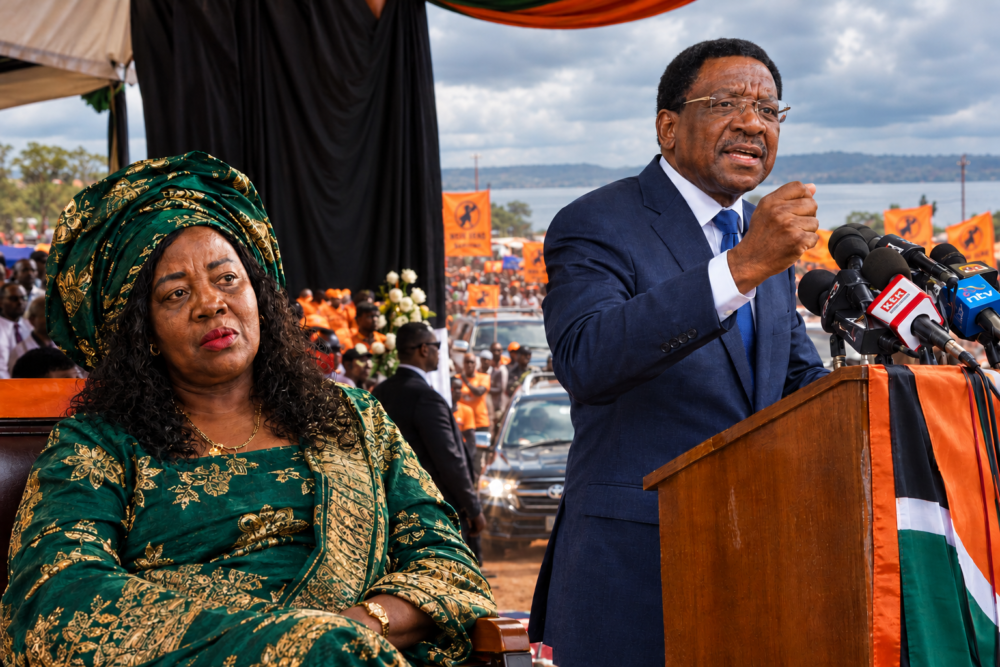
The pushback was instantaneous and incandescent. Stepping into the breach to shield the embattled matriarch, Siaya Governor James Orengo—the lone senior political heavyweight in Nyanza who refused to bend the knee to the broad-based administration—condemned the attacks as an act of grotesque “treachery and betrayal” executed by political mercenaries. Orengo openly accused the ministers of running an auction house: liquidating Raila’s hard-won democratic legacy to line their pockets and deliver the Luo Nation into the hands of the ruling United Democratic Alliance (UDA) ahead of the 2027 general elections.
As the dust settles over Migwena, one reality is indisputable: the battle for the inheritance of Kenya’s most cohesive voting bloc has moved from coded whisper campaigns to full-scale political warfare.
The Spark at Migwena: An Unforgivable Guest List
To understand why a memorial service degenerated into an ideological brawl, one must trace the guest list compiled by Mama Ida Odinga.
Ida did not design the first anniversary as an endorsement of the status quo. Instead, she deliberately invited figures who represent an existential threat to President William Ruto’s re-election machinery. Chief among them was former Deputy President Rigathi Gachagua—the deposed, bitter kingpin of Mt. Kenya politics who has spent the last two years fashioning himself as the chief martyr of Ruto’s consolidation drive. Also invited alongside Gachagua was former ODM Secretary-General Edwin Sifuna, the sharp-tongued Nairobi Senator whose refusal to cooperate with the broad-based government has made him a hero to the urban youth and a persistent thorn in the side of State House.
For the pro-government wing of ODM, the optics were an unmitigated disaster.
Under the broad-based architecture brokered in the tumultuous days after the Gen Z revolt of June 2024, President Ruto had ceded critical economic portfolios—the Treasury to Mbadi, Energy to Wandayi, Cooperatives to Wycliffe Oparanya, and Mining to Hassan Joho—in exchange for an explicit political deliverable: the pacification of Nyanza and the incorporation of the Luo voting bloc into the ruling coalition’s 2027 electoral column.
By seating inviting Gachagua, who could not make it there as he was away in ht eUnited States, and Sifuna to the high table at Migwena, Ida Odinga sent a thunderous signal to the grassroots: the Odinga family does not consider itself bound by the transactional arrangements of Ruto’s cabinet appointees.
To the ministers, this was not merely family independence; it was political sabotage. If the Odinga family provides safe harbor and moral legitimacy to Ruto’s most potent adversaries, the Cabinet Secretaries’ value proposition to State House evaporates. They risk being seen not as regional generals delivering a unified constituency, but as overpaid technocrats presiding over a phantom army.
The Anatomy of a Rebellion: Two Irreconcilable Wings
The events at Migwena crystallized a fundamental ideological split that has been metastasizing within the Orange party ever since Raila’s departure created a power vacuum at the center of Kenyan politics.
                  THE POST-RAILA ODM FACTIONAL SCHISM
                  ===================================

    THE PRO-GOVERNMENT / "BROAD-BASED" WING
    Principals: John Mbadi, Opiyo Wandayi, Junet Mohamed, Dr. Oburu Odinga
    ───────────────────────────────────────────────────────────────────────
    • Core Premise: The post-Raila era requires pragmatic co-governance.
    • Strategy: Trade ODM's parliamentary leverage for executive patronage.
    • Stance on Family: The Odinga name is not an automatic hereditary title;
      the party must break free from dynastic control to survive.
    • Ultimate Target: Deliver Luo Nyanza into Ruto's 2027 re-election machine.

                                     VS.

    THE TRADITIONALIST / "RESISTANCE" WING
    Principals: Mama Ida Odinga, Gov. James Orengo, Sen. Edwin Sifuna,
                Winnie Odinga, Babu Owino
    ───────────────────────────────────────────────────────────────────────
    • Core Premise: ODM is a liberation movement, not a commodity.
    • Strategy: Align with disenfranchised anti-Ruto factions (Mt. Kenya/Youth).
    • Stance on Family: Ida remains the moral compass; Winnie
      represents the authentic ideological succession.
    • Ultimate Target: Preserve ODM as an independent progressive force for 2027.
The pro-government wing, which enjoys the tacit, cautious blessings of Raila’s elder brother, Senator Dr. Oburu Odinga, operates on the logic of cold realpolitik. Their calculation is simple: after decades of “exclusion” from executive power, the Luo community cannot afford another cycle in the cold. With billions of shillings flowing through Mbadi’s Treasury and Wandayi’s Energy dockets for rural electrification and infrastructural works in the lake basin, they argue that direct partnership with Ruto is the only rational economic path.
To them, Mama Ida’s romantic attachment to opposition politics threatens to derail this developmental dividend. Furthermore, men like Mbadi and Wandayi have harbored personal ambitions for years. Having spent their careers operating in the shadow of Agwambo, they view Raila’s death not as an insurmountable tragedy, but as an opportunity for personal emancipation. They do not wish to trade one master for a committee of his heirs.
The traditionalist wing, anchored by Ida, Orengo, and the rising scion Winnie Odinga, views this calculation as shortsighted opportunism. To them, the broad-based government is a classic co-optation maneuver—a strategy straight out of the old KANU playbook, designed to dismantle Kenya’s most storied opposition movement by luring its senior lieutenants with ministerial flags and motorcades.
Orengo’s Red Line: Freedom Fighter, Not a Political Widow
It was against this backdrop that Governor James Orengo delivered his blistering defense of Mama Ida. Among the surviving veterans of the Second Liberation, Orengo occupies a unique moral plateau. Having shared prison cells and underground safe houses with Raila during the height of the Daniel arap Moi dictatorship, he possesses an institutional authority that the younger ministers cannot match.
Addressing a gathering of charged supporters in Siaya, Orengo did not mince his words. He branded the public attacks on Ida an act of unforgivable cowardice, pointing out the historical absurdity of junior politicians attempting to lecture a woman who had paid for the country’s democracy in blood and tears.
“Mama Ida is not a passenger in this struggle; she is a decorated combatant in her own right,” Orengo stated, his voice trembling with controlled fury. He recounted the dark years of the 1980s and 1990s when Raila was detained without trial, leaving Ida to raise their young children under relentless round-the-clock state surveillance, systematic intimidation, and arbitrary arrests. “When these young men were still in primary school or looking for internships, Mama Ida was looking the state security apparatus in the eye, keeping the flame of freedom alive. For them to stand on public podiums today and claim she must prove her worth to them is the height of political depravity.”
Orengo then delivered the coup de grâce, accusing Mbadi, Wandayi, and Junet of executing an unauthorized fire-sale of the Orange movement. “They have taken the party of the people and put it on an auction block in Nairobi,” Orengo charged, punctuating his speech with a pointed Luo proverb on ingratitude: “Guok mikwayo e makayo lueti”—the dog you feed and raise from a pup is often the first to turn and sink its teeth into your hand.
The Sifuna Variable: The Youth Vanguard vs. The Cabinet Barrons
While Orengo provides the traditionalist wing with its legal and moral armor, the operational engine of the resistance belongs to Edwin Sifuna.
As ODM Secretary-General, Sifuna held the administrative keys to the party machinery. Unlike Mbadi and Wandayi, who had to surrender their party executive posts upon taking up Cabinet Secretary portfolios under Article 75 of the Constitution, Sifuna remained firmly entrenched at Orange House. He was the custodian of the party seal, the manager of the nomination structures, and the public face of the party’s communications. He was remove from that position, a move that only grew his influence and power more, making him an overnight threat, in fact the greatest threat at the moment, to Ruto’s re-election ambitions.
Sifuna’s entry into this dispute fundamentally alters the balance of power. While the ministers hold executive leverage and control over regional development funds, Sifuna commands the microphone and the loyalty of the party’s most active demographic: the under-35 voters who took to the streets during the historic Gen Z protests and who view the broad-based government with utter contempt.
                    THE BALANCE OF LEVERAGE
                    =======================

    BROAD-BASED MINISTERS          SIFUNA & TRADITIONALISTS
    ─────────────────────          ────────────────────────
    • National Treasury Spigot     • New Party Gaining Pouplarity
    • State Security Apparatus     • Control of 2027 Party Tickets
    • Executive Patronage & Jobs   • Grassroots Emotional Loyalty
    • State House Support          • Youth / Gen Z Demographic
    • Institutional Media Access   • Alignment with Mt. Kenya Rebels
Sifuna’s calculus is intensely pragmatic. He recognizes that if ODM is fully subsumed into Ruto’s re-election campaign, the party will forfeit its unique identity and alienate its massive urban base in Nairobi, the Coast, and the youth centers. By standing shoulder-to-shoulder with Mama Ida and facilitating the platform for figures like Rigathi Gachagua, Sifuna is doing two things simultaneously:
-
Protecting the Brand: He is preserving Raila Odinga’s market value as an independent, fighting opposition hero whose memory whose followers can dictate terms rather than beg for inclusion.
-
Building an Alternative Coalition: He is laying the foundation for a formidable 2027 counter-alliance—a political axis bringing together the restless Luo grassroots, the aggrieved Mt. Kenya electorate led by Gachagua, the huge Western Luhyia voting base and urban progressives tired of both traditional dynastic politics and broad-based patronage.
When Mbadi and Wandayi attack Ida, they are indirectly attempting to undermine Sifuna. They know that as long as Ida provides political cover to the former Secretary-General, their efforts to use party organs to discipline dissenting MPs or force followers into an unpopular official merger with UDA will remain dead on arrival.
The Motivations: Why Gang Up on the Matriarch Now?
The decision by Mbadi, Wandayi, and Junet to break the ultimate taboo and openly attack Mama Ida is not an emotional lapse; it is a calculated, desperate necessity driven by three distinct structural pressures.
First, the ticking clock of the 2027 election cycle. President Ruto is an exacting political master. He did not invite senior ODM leaders into his cabinet out of charity; he brought them in to neutralize western Kenya. As the election draws nearer, State House will demand tangible evidence that the lake region is secure. With Ida actively welcoming Gachagua and signaling non-alignment, the ministers are panicked that their political currency in Nairobi is rapidly depreciating. Attacking Ida is an aggressive, high-risk gambit to shock the Luo base into decoupling from the family name.
Second, the dread of the emerging scions. The pro-government faction had hoped that with Raila gone, the Odinga family would quietly fade into comfortable, ceremonial retirement. The sudden political ascendancy of Winnie Odinga—who has declared her bid for the Nairobi Senate seat—and Raila Odinga Jnr, who is actively staking his claim to his father’s old stomping ground in Kibra, has triggered alarm bells across the established political class. The ministers realize that if Winnie and Junior establish independent electoral beachheads in the capital, the Odinga brand will renew itself for another forty years, permanently capping the ambitions of the older technocrats.
Third, the Junet Dilemma. For years, Junet Mohamed operated as Baba’s indispensable gatekeeper, wielding immense behind-the-scenes influence. In the post-Raila dispensation, however, Junet finds himself increasingly isolated. Having skipped the Migwena memorial under the controversial pretext that “Baba’s enemies” were present, he has faced mounting accusations of bad faith. For Junet, joining Mbadi and Wandayi in an aggressive offensive against the family’s current posture is a way to construct an alternative center of power where he remains a kingmaker, rather than an outcast pleading for relevance at Kang’o ka Jaramogi.
Analysis: Who Will Emerge as the Eventual Winner?
As the civil war deepens, who ultimately prevails in this existential struggle for the soul of Nyanza?
To project the victor, one must look at the history of Luo political behavior over the past sixty years. On several occasions, powerful figures backed by the full financial and security machinery of the state attempted to wrestle the community away from the Jaramogi and later Raila grips. In the 1960s, Tom Mboya commanded the state resources of Jomo Kenyatta’s administration; yet the grassroots remained fiercely loyal to Jaramogi Oginga Odinga. In the 1980s and 1990s, figures like Ndolo Ayah and Dalmas Otieno had the backing of President Moi’s formidable KANU apparatus; yet when the ballots were cast, the community voted overwhelmingly with the dissident Odinga faction.
The Luo electorate has historically demonstrated an almost visceral immunity to state patronage when it feels its collective dignity and political independence are being traded away.
While John Mbadi and Opiyo Wandayi possess the Treasury spigot, state helicopters, and the power to pave rural roads, these assets have historically failed to translate into organic political loyalty in Nyanza. Development projects are viewed by the community as constitutional entitlements, not personal favors from ministers. When those same ministers use their positions to publicly disparage the family that embodied their political struggles for half a century, they cross an invisible, deeply emotional line.
The Traditionalist-Resistance Coalition—anchored by the moral authority of Mama Ida, the intellectual and legal gravitas of James Orengo, and the youthful, aggressive operational machinery of Edwin Sifuna and Babu Owino—holds the superior strategic position.
The ultimate winner of this contest will not be the ministers attempting to manage the community on behalf of State House. The winner will be the faction that captures the imagination of the new generation while preserving the emotional sanctity of the liberation struggle.
By taking the fight to Mama Ida, Mbadi, Wandayi, and Junet have committed the cardinal sin of regional politics: they have mistaken the possession of state office for the possession of the people’s hearts. In doing so, they have not broken the Odinga dynasty; they have merely provided James Orengo, BabuOwino and Edwin Sifuna with the ultimate political weapon to cast them as mercenaries—ensuring that when the 2027 reckoning arrives, the orange flag will remain firmly in the hands of those who refused to sell it.