
Luo Nation at Crossroads on Raila 1st Anniversary
By Coursel.Online Political Desk
The wind blowing across the shores of Lake Victoria carries a different, heavier cadence this year. It has been exactly twelve months since the curtain fell on the most colorful, tumultuous, and consequential political career in modern Kenyan history. One year since Raila Amolo Odinga—the enigma, the phenomenon, the undisputed ‘Baba’ of Kenyan politics—transitioned from the realm of the living into the pantheon of African political ancestors.
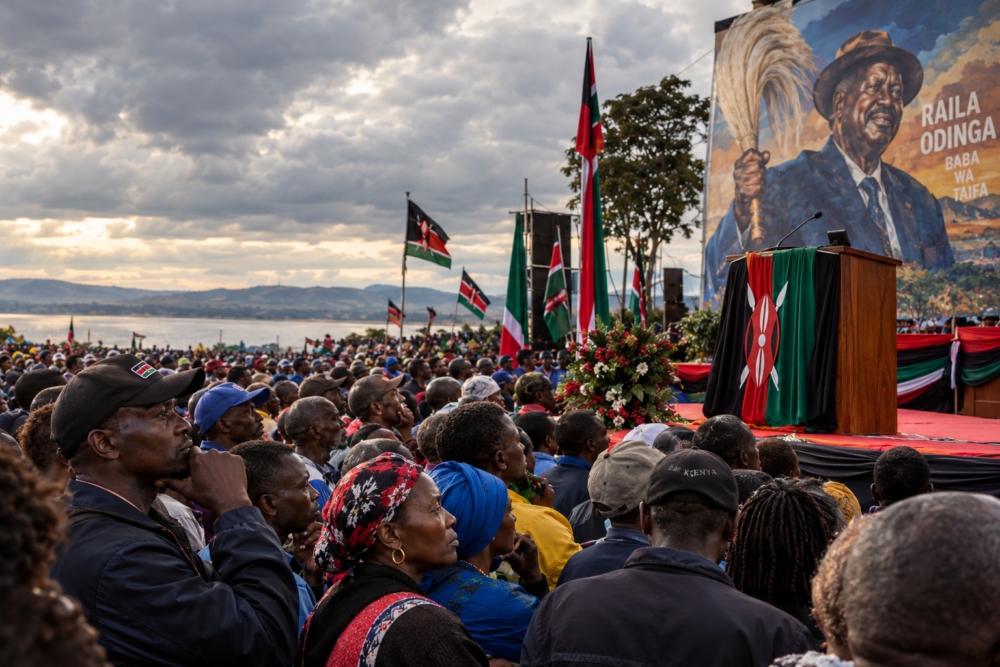
As the Luo Nation, and indeed the entire country, paused to mark the first anniversary of his passing, the commemorative events at Migwena laid bare a stark, undeniable reality: the Luo Nation is standing at a monumental political crossroads. The vacuum left by Agwambo is vast, echoing with the whispers of succession, the murmurs of betrayal, and the loud, unmistakable drums of a new political generation stepping up to the plate.
The Migwena Memorial: Ida Odinga’s Stoic Resolve
The memorial at the historic Migwena grounds in Bondo was supposed to be a unifying moment, a solemn reflection on the life of a man who spent over four decades fighting for Kenya’s second liberation and democracy. At the center of it all was Dr. Ida Odinga, affectionately known as Min Piny (Mother of the Nation).
In a message that was as stoic as it was profoundly revealing, Ida did not dwell on the grief that has undoubtedly clouded the Odinga homestead. Instead, she issued a clarion call for unity, economic liberation, and political resilience. “He did not fight for a fragmented people,” Ida told the thousands gathered, her voice steady, cutting through the humid Bondo air. “Raila’s dream was never about blind loyalty to an individual; it was about the collective prosperity and the unyielding defense of our democratic ideals. Do not let his sacrifices be the altar upon which you sacrifice your unity.”
Her message was a thinly veiled indictment of the simmering factional wars currently threatening to tear the region’s political fabric apart. Ida’s posture was that of a matriarch desperately trying to hold together a house whose main pillar has been removed. Yet, even her powerful words could not mask the glaring, uncomfortable truth of the day: the conspicuous absence of the men and women who, just a few years ago, would have traded their right arms for a photo opportunity next to Baba.
The Missing Loyalists and the Betrayal of the Coat-tails
If politics is a game of optics, then the optics at Migwena were deeply troubling. A significant faction of politicians—governors, senators, and vocal MPs who rode the ODM wave into office, clutching tightly to Raila’s coat-tails—were nowhere to be seen.
These are the ‘political orphans’ who spent their entire careers hiding their personal incompetencies behind Raila’s massive political shadow. For decades, securing an ODM ticket in Nyanza was akin to a direct ticket to political office, guaranteed merely by declaring unwavering loyalty to Tinga. Today, with the sun having set on the patriarch, these politicians are suddenly charting new courses, actively flirting with rival political formations, and conspicuously avoiding the Migwena memorial probably to avoid offending their new political masters in Nairobi, or facing an unpredictable crowd that would have shouted them down.
Their absence was a loud statement. It signaled the beginning of the end of the monolithic voting bloc that Nyanza has historically been. The scramble for the Luo Nation’s soul is no longer a localized affair; it has been commercialized, auctioned to the highest bidder by the very generals who once guarded the Odinga fortress.
The Junet Paradox: Misunderstanding the Man
Perhaps the most controversial, and frankly baffling, moment of the anniversary weekend was the statement issued by Suna East MP Junet Mohammed. Once considered the ultimate insider, the gatekeeper who commanded the ear of Baba, Junet’s absence at Migwena raised eyebrows. His explanation, however, raised bile.
Speaking from a different location, Junet audaciously claimed that he skipped the memorial because “Baba’s enemies were at Migwena,” implying that the presence of rival political figures and dissenting local leaders at the Bondo event made it a hostile environment, and one that Raila himself would have purportedly shunned.
This statement is not just a weak political excuse; it is a fundamental misreading, if not a deliberate insult, to the character of Raila Amolo Odinga.
If there was one defining trait of Raila’s political DNA, it was his extraordinary, almost superhuman capacity for political magnanimity and bravery. To suggest that Agwambo would cower or fail to show up because his “enemies” were present is to rewrite history with a pen of cowardice. This is the man who looked Daniel Arap Moi in the eye and joined KANU in a strategic masterstroke. This is the man who, after a bitterly disputed and bloody election in 2007, sat at the same table with Mwai Kibaki to forge a coalition government for the sake of the country. This is the leader who shocked the world by shaking hands with Uhuru Kenyatta on the steps of Harambee House in 2018, and later found common ground with William Ruto when the nation teetered on the brink following the Gen Z reveolt of June 24, 2024 when William Ruto’s government had virtually collapsed.
Raila never ran from his enemies. He walked directly into their camps, sat at their tables, and outmaneuvered them with charm, wit, and tactical genius. He thrived in the presence of his detractors. For Junet—a man who claims to be a student of Odingaism—to use the presence of “enemies” as an excuse to avoid honoring the patriarch is a testament to how far the current crop of leaders has strayed from the courage that defined their mentor.
The Heirs Apparent: Winnie and Junior Step into the Arena
Nature abhors a vacuum, and politics abhors it even more. With the traditional Nyanza elite squabbling over table scraps, the Odinga family is decisively signaling that they are not ready to retreat into the shadows of history. The 1st anniversary marked the unofficial launchpad for the next generation of the Odinga dynasty, with Winnie Odinga and Raila Odinga Jnr making seismic political declarations.
Winnie Odinga, long viewed as the ideological and temperamental heir to her father, has officially declared her intention to run for the Nairobi Senator’s seat. Winnie is a firebrand. She has the gravelly defiance of her grandfather Jaramogi and the grassroots charisma of her father. By targeting Nairobi—a complex, cosmopolitan battleground rather than a safe seat in Nyanza—Winnie is making a massive statement. She is not asking for a political inheritance; she is seeking to conquer her own territory. Her bid for Nairobi is a calculated gamble. If she wins, she cements herself as a national leader in her own right. If she loses, it could severely dent the family’s aura of invincibility.
On the other hand, Raila Odinga Jnr, the traditionally quieter, behind-the-scenes strategist, has set his sights on the Kibra Parliamentary seat. Kibra is the spiritual Mecca of Odinga politics. It is the constituency that nurtured Raila, the bedrock of his urban, working-class support base. Junior’s move is deeply symbolic. By returning to Kibra, he is attempting to reconnect the Odinga brand with the struggling masses, the hustlers who genuinely viewed Baba as their voice. Junior’s approach is expected to be methodical, relying on legacy but needing to rapidly prove his own capability to handle the unforgiving, rugged terrain of Kibra politics.
A Nation at the Crossroads
So, where does this leave the Luo Nation?
The community is caught in a profound transition. On one side, there is the lingering loyalty to the Odinga name, carried forward by Ida’s steadfastness, Winnie’s fiery ambition, and Junior’s symbolic return to the grassroots. On the other side is a fractured political elite—the Junets, the absentee governors like Gldys Wanga and jelly-kneed Ochilo Ayacko, the shifting loyalists—who believe that the era of central command is over and that Nyanza is now a free-market political economy they can auction to Ruto.
What the Luo Nation urgently needs is not a replacement for Raila Odinga—because there will never be another one. What is required is a radical reimagining of its political strategy. For decades, the region’s politics was driven by the quest for the ultimate prize: the presidency. Today, the conversation must shift to economic consolidation, strategic alliances based on developmental interests rather than blind hero-worship, and holding the emerging leaders accountable.
The crossroads at Migwena was more than a physical location; it was a psychological reckoning. The people of Nyanza must decide whether to allow the region to be cannibalized by self-serving politicians using the excuse of “enemies,” or whether to rally behind a new, progressive vision that honors Raila’s legacy by evolving beyond it.
As Winnie and Junior step onto the battlefield, they must realize that the coat-tails are gone. The grace period of mourning is over. The voters in Kibra, Nairobi, and the shores of Lake Victoria will not vote for a memory; they will demand a future.
What are your thoughts on the unfolding succession politics in Nyanza? Will Winnie and Junior successfully carry the mantle, or is it time for fresh blood outside the Odinga family? Dive deeper into our political analysis and share your views in the comments below. Bookmark Coursel.Online for the most fearless, realistic, and uncompromised journalism in Kenya.