
By the Coursel.Online Investigative and African Affairs Desk
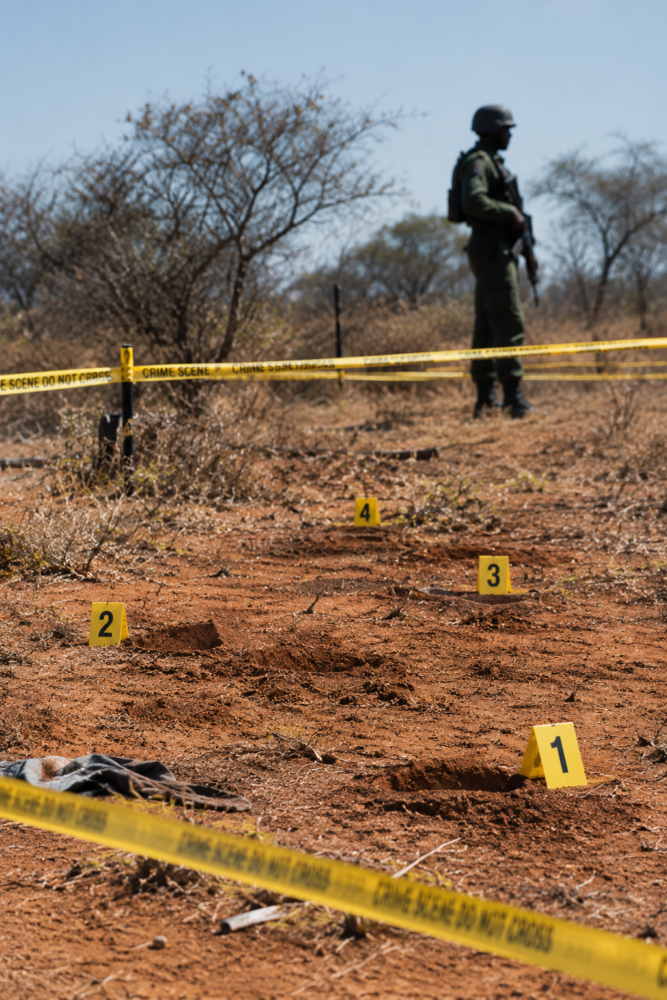
MOMBASA, Kenya—For more than three years, the rust-red soil of the Shakahola Forest has kept a horrific, silent tally of Kenya’s institutional failures. On Monday, October 19, 2026, the judicial reckoning finally arrived.
Inside a heavily guarded courtroom in the coastal city of Mombasa, High Court Judge Diana Kavedza Mochache handed down a watershed verdict, finding self-proclaimed doomsday pastor Paul Nthenge Mackenzie and 28 of his most devoted followers guilty of murder. The scale of the conviction is as staggering as it is deeply disturbing: the 29 defendants were convicted specifically of the murder of 191 people—a toll consisting of 190 children and a single adult.
The ruling marks the first major legal domino to fall in the wake of the Shakahola Forest Massacre, widely regarded by international criminologists and religious scholars as one of the worst cult-related mass casualties in modern history. Yet, behind the sterile legal terminology of the charge sheets lies a harrowing saga of charismatic manipulation, the commercialization of faith, absolute authoritarian control, and a sovereign state that repeatedly looked the other way.
The Architect of the End Times
The man at the center of the slaughter did not begin his career as a mastermind of mass death. Paul Nthenge Mackenzie was once a modest, soft-spoken taxi driver. In 2003, capitalizing on the explosive growth of unregulated Pentecostalism across East Africa, he founded the Good News International Church. Over the next decade, Mackenzie transformed from a fringe street preacher into a powerful evangelical figure, amplifying his reach through his dedicated broadcast network, Times TV.
His doctrine was rooted in an extreme, uncompromising apocalyptic vision. Mackenzie claimed to possess exclusive prophetic insights that the end of the world was imminent. To prepare for this localized rapture, he required complete detachment from the secular world. From the pulpit, he instructed his followers to shun formal education, pull their children out of schools, and avoid modern healthcare entirely. In Mackenzie’s theology, hospitals, medical treatments, and government infrastructure were not public goods—they were the literal “instruments of Satan” designed to permanently corrupt the souls of the faithful.
By 2019, mounting public scrutiny and minor clashes with local authorities prompted Mackenzie to close his physical church compound in Malindi. He ordered his followers to liquidate their assets, abandon their communities, and relocate to a highly secluded, 800-acre commune deep inside the unforgiving brush of the Shakahola Forest. To cement the illusion of a holy sanctuary, Mackenzie divided the vast, arid encampment into sectors bearing biblical names, such as “Jerusalem” and “Judea”.
Once the followers were isolated from their extended families and stripped of their earthly wealth, the commune’s true, lethal purpose was activated.
The Hierarchy of Death
The narrative initially surrounding the Shakahola tragedy was one of a voluntary mass suicide pact—a tragic but consensual yielding to religious fervor. However, the exhaustive criminal trial, supported by forensic pathology and survivor testimonies, proved definitively that Mackenzie ran a highly organized, militarized “hierarchy of death” designed to systematically enforce mass starvation.
According to evidence presented in court, Mackenzie decreed that in order to “meet Jesus” and escape the impending apocalypse, families were required to fast until death. But the dying was not chaotic; it was meticulously sequenced. The court established that the directive was ruthlessly implemented by targeting the most vulnerable first. Children were forced to starve at the onset. Once the children had perished, the mandate fell to the teenagers, then the women, and finally, the remaining men. Justice Kavedza noted the agonizing reality that, in many instances, children were isolated and denied sustenance while their parents passively watched.
For those whose survival instincts overrode their indoctrination, the commune became a brutal prison camp. Mackenzie utilized armed enforcers and loyalist guards to heavily patrol the forest perimeter. Cult members were housed in squalor under makeshift polythene sheeting and thatch. If children or adults attempted to escape the compound, break their mandated fast, or forage for wild berries and roots, they were physically restrained, severely beaten, or murdered outright.
While forensic experts determined that the vast majority of the victims succumbed to extreme starvation, post-mortem examinations revealed a much darker truth regarding the commune’s internal policing. Several children and adults were found to have died from asphyxia, strangulation, neck compression, and blunt-force trauma to the head. This forensic data was the linchpin of the prosecution’s murder case: it proved beyond a reasonable doubt that those who resisted the forced fasting were actively and violently executed.
The horror only came to light in April 2023 when a desperate local citizen reported to the police that his brother and wife had relocated to the forest and were starving their children. The resulting police raid ruptured the secrecy of the commune. What began as a rescue mission rapidly devolved into a sprawling forensic exhumation. Over the subsequent months, investigators with ground-penetrating radar uncovered hundreds of shallow graves dotting the forest floor. To date, well over 400 bodies have been recovered from the Shakahola site.
A Charismatic Charlatan, Not a Martyr
In the aftermath of such incomprehensible loss, sociologists and criminal psychologists often debate the internal motivations of cult leaders. Was Mackenzie a genuine, albeit deeply delusional, believer in his own apocalyptic prophecies, or was he a calculating predator? The evidence unearthed during the investigation points overwhelmingly to the latter: Mackenzie was a charlatan who weaponized religious belief to exert ultimate power, wealth, and control.
True “believers” in doomsday pacts typically perish alongside their flock, embracing the end they prophesied. Mackenzie did no such thing. While he demanded his followers strip themselves of their possessions, deny their children food, and slowly waste away in the dirt, Mackenzie and his immediate family were found well-fed, hydrated, and entirely healthy at the time of his arrest. He blatantly abstained from the final, fatal phases of the death pact he had strictly mandated for others.
Furthermore, investigators uncovered handwritten financial notes inside Mackenzie’s prison cell following his initial detention. The documents revealed that the former taxi driver was actively managing mobile money transactions and attempting to maintain control over liquidated assets and properties from behind bars. He did not behave like a man preparing for the end of the world; he behaved like a malignant narcissist protecting a diversified portfolio.
He had successfully built an insulated fiefdom where he operated as the undisputed mouthpiece of the divine, utilizing armed militias to enforce absolute dominion over the lives, and ultimately the deaths, of desperate and vulnerable people.
Institutional Paralysis and the African Evangelical Ecosystem
As the horrific details of the Shakahola massacre dominated global headlines, an uncomfortable spotlight was turned upon the Kenyan government. The tragedy sparked massive public outrage regarding the state’s structural failure to protect its citizens.
Mackenzie was not an unknown entity to the Kenyan intelligence or policing apparatus. It was revealed that he had been arrested in 2017 on charges of radicalization, and again in 2019 in connection with child deaths. Yet, in both instances, he was repeatedly released on cash bail, effectively granting him the operational freedom to pull his followers deeper into the wilderness away from the prying eyes of the law. Even the country’s national rights commission concluded that the state had failed spectacularly, citing missed opportunities to act on intelligence warnings and severely delayed investigations. President William Ruto publicly conceded that government agencies should have prevented the massacre, taking ultimate responsibility for the intelligence failure.
This institutional paralysis highlights a broader, continent-wide dilemma. Across Kenya and much of Sub-Saharan Africa, there exists a massive, largely unchecked ecosystem of independent evangelical and pentecostal ministries. In nations where formal social safety nets are weak, charismatic preachers often step into the void, offering a potent mix of prosperity gospel, spiritual healing, and community.
Because religion plays a deeply prominent role in public life, politicians frequently court these megachurch leaders for their massive, unified voting blocs. As a result, the state is heavily reluctant to regulate religious organizations, fearing accusations of infringing upon the freedom of worship. The Shakahola tragedy has placed immense pressure on Nairobi to heavily reform and regulate this sector, recognizing that without oversight, the line between a church and an extortionate, lethal cult is easily erased.
Historical Echoes of Absolute Devotion
The sheer scale of the Shakahola tragedy heavily echoes the darkest chapters of historical doomsday cults. The mechanics of isolation, absolute authoritarianism, and mass death draw unavoidable parallels to the Movement for the Restoration of the Ten Commandments of God in Kanungu, Uganda. In 2000, after their prophecy of the apocalypse failed to materialize, the movement’s leaders orchestrated a mass poisoning and church fire that claimed the lives of over 700 followers.
Similarly, the Shakahola massacre evokes the grim memory of the Jonestown Peoples Temple in Guyana in 1978, where Jim Jones forced over 900 followers—including more than 300 children—to consume cyanide-laced punch under the watchful eyes of armed guards. In all these instances, the vulnerability of the followers was exploited by a charismatic leader who demanded that the ultimate proof of faith was the surrender of life itself.
The Legal Horizon: Mitigation and Beyond
While the October 19 verdict provides a measure of closure for the devastated families—such as Francis Wanje, who lost eight family members, including two grandchildren, to the cult—the legal saga is far from over.
High Court Judge Diana Kavedza Mochache has scheduled a formal mitigation hearing for October 30, with the final sentencing set to be delivered on November 6, 2026. Because Kenya still retains the death penalty on its statutes (though no executions have been carried out since 1987, and sentences are routinely commuted to life imprisonment), Mackenzie and his inner circle face the absolute maximum penalties permissible under Kenyan law.
Furthermore, this murder conviction represents only a fraction of the cult’s legal exposure. Mackenzie and his 94 co-defendants still face an array of separate, ongoing criminal trials in other courts for terrorism, radicalization, manslaughter, torture, and child cruelty.
The prosecution is also pressing separate, highly severe charges against Mackenzie for allegedly masterminding the deaths of 52 additional victims at a secondary commune site in the nearby village of Kwa Binzaro. Chillingly, evidence suggests that the Binzaro site continued its lethal starvation operations even after Mackenzie’s initial arrest in April 2023, operating on the delayed, unrescinded orders of its imprisoned prophet.
As Paul Mackenzie awaits his final sentencing, sitting impassively in his striped polo shirt and red trousers, he serves as a grim monument to the lethal potential of unchecked charisma. The Shakahola Forest has been cleared of its dead, but the structural vulnerabilities that allowed a taxi driver to declare himself a god and execute nearly 200 children remain deeply embedded in the region’s socio-religious fabric. The true legacy of this trial will depend not on how long Mackenzie remains behind bars, but on whether the Kenyan state can summon the political will to ensure the wilderness never claims so many of its vulnerable citizens again.