
Kenya’s Ebola Outbreak: How Institutional Fracture and Policy Blunders Compounded an Epidemic
By the Coursel.Online Bureau of Investigation and Public Policy
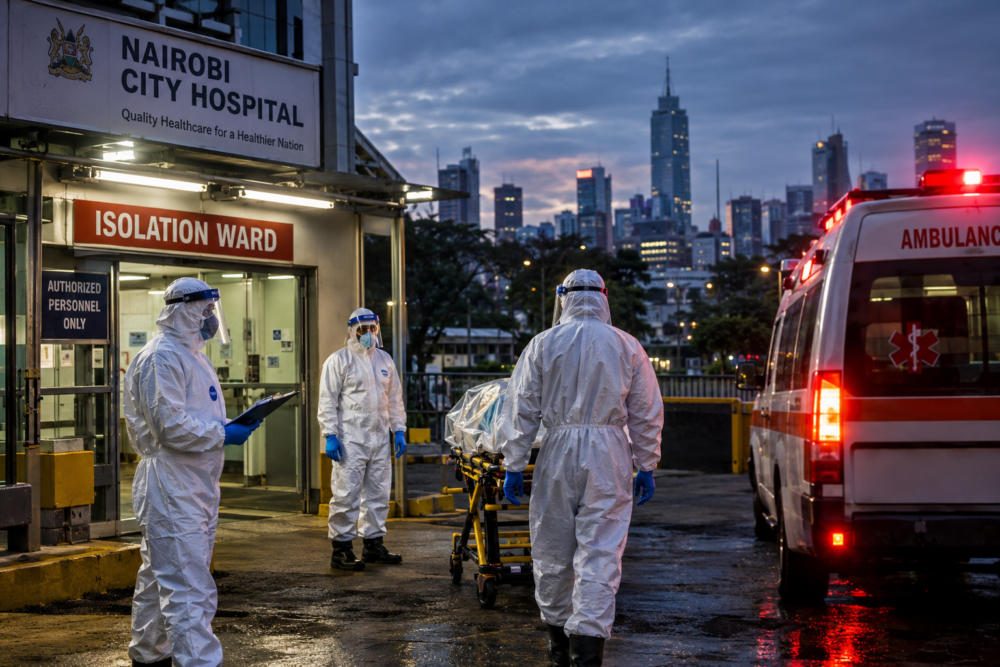
NAIROBI—Inside the high-dependency isolation unit of The Nairobi Hospital, the death of a 42-year-old regional agricultural trader late last week ceased to be an isolated medical tragedy and became an immediate crisis of state.
Subsequent laboratory sequencing by the Kenya Medical Research Institute (KEMRI) confirmed the presence of the Bundibugyo ebolavirus—a rare, virulent filovirus with a historical case fatality rate hovering near 40%. Within seventy-two hours, contact tracing across three counties confirmed six additional infections, including two healthcare workers.
For East Africa’s undisputed commercial capital, the arrival of hemorrhagic fever in its primary metropolis represents a severe operational test. Yet the unfolding crisis is not merely an epidemiological event; it is an unvarnished audit of Kenya’s public-sector governance.
Interviews with senior health administrators, county executives, and multilateral diplomats depict a response hobbled by policy reversals, chronic institutional mistrust, and an explosive controversy over a sovereign security arrangement: the operation of a state-of-the-art American biocontainment facility in Nanyuki from which infected Kenyan citizens are barred by treaty.
At the epicenter of the storm sits the Ministry of Health, spearheaded by Cabinet Secretary Aden Duale. As regional borders leak and public hospitals grapple with severe equipment shortages, the ministry faces accusations that years of fiscal centralization, abrupt policy rollbacks, and politicized procurement have hollowed out the country’s defenses at the precise moment they are needed most.
The Anatomy of an Outbreak: The Porous Corridors
The contagion’s trajectory illustrates the vulnerabilities inherent in East Africa’s interconnected transit corridors. The index patient, an entrepreneurial trader dealing in high-value timber and produce, initiated his journey deep within the resource-rich, conflict-riven borderlands of the eastern Democratic Republic of Congo (DRC).
Traversing the border via an informal crossing point north of Goma, he moved through southwestern Uganda by road before boarding a regional commercial flight bound for Jomo Kenyatta International Airport (JKIA) in Nairobi. By the time he exhibited acute febrile symptoms, including persistent vomiting and petechial hemorrhages, he had spent two days moving freely within Nairobi’s densely populated Eastleigh commercial district.
                  THE TRANSMISSION CORRIDOR
                  ==========================

   [ Eastern DRC: Ituri / North Kivu Borderlands ]
                         │
                         ▼  (Informal overland transit)
                 [ Western Uganda ]
                         │
                         ▼  (Commercial road freight)
             [ Entebbe Regional Airport ]
                         │
                         ▼  (Short-haul commercial flight)
         [ Jomo Kenyatta Int'l Airport (JKIA) ]
                         │
                         ▼  (Unscreened community transit)
             [ Nairobi: Eastleigh Hub ]
                         │
                         ▼  (Acute symptom onset)
            [ The Nairobi Hospital ICU ]
                         │
        ┌────────────────┴────────────────┐
        ▼                                 ▼
 [ Fatal Index Case ]           [ 6 Secondary Contacts ]
                                (2 Medics, 4 Community)
“What occurred at JKIA was a catastrophic failure of basic point-of-entry surveillance,” says a senior epidemiologist at the World Health Organization’s regional hub in Nairobi, speaking on condition of anonymity. “The thermal scanners at terminal arrival gates were either uncalibrated or intermittently unmanned. We observed a patient with an elevated temperature slip through standard screening simply because regional land-border transit logs were never digitized or integrated with airport border management systems.”
The Bundibugyo strain presents a distinct diagnostic challenge. Unlike the Zaire strain, for which the Ervebo vaccine offers established protection, Bundibugyo lacks a commercially licensed prophylactic countermeasure. Ring-vaccination protocols, which successfully contained recent outbreaks in Uganda and the DRC, cannot be immediately deployed. Management relies almost exclusively on aggressive, early supportive therapy: intravenous fluid replacement, hemodynamic stabilization, and absolute isolation to prevent secondary transmission chains.
Yet in a public health system characterized by fractured regional communication and understocked peripheral health posts, early containment is a fragile premise.
The Nanyuki Conundrum: Sovereign Soil, Foreign Treatment
If the clinical reality has rattled the medical fraternity, the geopolitical optics of the containment effort have ignited public fury.
Seventy miles north of Nairobi, nestled within the perimeter of the Laikipia Air Base—an active installation of the Kenya Air Force—sits an ultra-modern, biosafety level 4 (BSL-4) field containment center. Built and financed by the United States Department of Defense, the facility was designed to manage high-threat pathogen exposures for Western military personnel, intelligence operatives, and diplomatic personnel stationed across East and Central Africa.
It is, by every physical metric, the most advanced bio-containment asset on Kenyan soil, equipped with positive-pressure personnel suits, dedicated waste-sterilization autoclaves, and experimental antiviral stockpiles.
It is also, by contractual design, completely off-limits to Kenyans.
Under the terms of a classified bilateral status-of-forces and defense health cooperation agreement negotiated during the first Trump administration, access to the Nanyuki unit is strictly restricted to U.S. citizens and individuals granted explicit, case-by-case clearance by the American military command in Stuttgart and the U.S. Embassy in Nairobi. When county health officials from neighboring Laikipia and Meru requested access to the facility’s negative-pressure chambers for two high-risk secondary contacts awaiting definitive PCR confirmation, the request was rebuffed.
The refusal has unleashed a firestorm of sovereign indignation. Civil society coalitions and legal associations have labeled the arrangement “medical apartheid,” alleging that senior elements of the previous national administration accepted substantial off-budget security subsidies and defense modernization grants in exchange for granting Washington extraterritorial immunity and unilateral operational control over the base.
“The idea that we host a premier containment center on Kenyan military territory while our own physicians are forced to isolate suspected Ebola patients behind makeshift plastic sheeting in Kiambu is unconscionable,” said Gitobu Imanyara, a prominent constitutional lawyer and former parliamentarian. “It represents a total abrogation of sovereign dignity and constitutional duty. Article 43 guarantees the right to the highest attainable standard of health. Here, the state has contracted out sovereign land to create an enclave of privilege in the middle of a national security emergency.”
Cabinet Secretary Duale has pushed back aggressively against the criticism, insisting the facility’s terms predated his tenure and remain bound by international treaty. “Our collaboration with foreign defense partners is based on bilateral defense protocols,” Duale said during an acrimonious press conference in Nairobi. “The Nanyuki asset is part of an international strategic partnership. We do not compromise sovereign security, and the government is fully capable of managing its own citizens within our national referral ecosystem.”
Yet Duale’s defense has done little to placate an anxious populace, especially as the referral ecosystem he touts buckles under structural dysfunctions of its own making.
Devolution Under Fire: The SHA Fiasco
The timing of the outbreak could hardly be worse. Kenya’s health architecture is structurally devolved under Schedule IV of the 2010 Constitution, which assigns the primary responsibility for county health service delivery to forty-seven semi-autonomous regional governments, while reserving national policy, national referral hospitals, and technical standards for the central ministry.
In practice, that decentralization has evolved into an administrative civil war.
The crisis has been intensified by the ministry’s decision to dismantle the National Hospital Insurance Fund (NHIF) in favor of the newly minted Social Health Authority (SHA). Championed by the Ruto administration as a bold step toward universal healthcare, the transition has instead produced systemic administrative paralysis. Hospitals across the country have faced frozen reimbursement accounts, disrupted patient registries, and an IT infrastructure marred by persistent operational downtime.
In Murang’a County, the disruption prompted an open rebellion by Governor Dr. Irungu Kang’ata. A Stanford-educated legal scholar, Kang’ata had developed a bespoke, automated municipal health management system—Kang’ata Care—which integrated local patient records, drug inventories, and subsidized insurance for vulnerable families.
Late last month, the Ministry of Health issued a sweeping regulatory directive ordering county governments to decommission local digital registries and migrate all records to the centralized, glitch-ridden national SHA platform.
       HEALTH GOVERNANCE: THE JURISDICTIONAL SPLIT
       ===========================================

       NATIONAL GOVERNMENT           COUNTY GOVERNMENTS
       (Ministry of Health / Duale)  (47 Devolved Units)
       ---------------------------   ------------------
       • National Referral Centers   • Primary Care Clinics
       • Border Biosecurity & Ports  • County Referral Centers
       • Regulatory Directives       • Medical Staff Payroll
       • Control of Fiscal Transfers • Local Drug Inventory
                    │                        ▲
                    │ Policy / Funding Gate  │
                    └────────────────────────┘
The consequence was immediate operational failure. Health workers in Murang’a lost real-time access to patient histories, pharmaceutical logistics froze, and diagnostic tracking broke down precisely as surveillance protocols for hemorrhagic fevers were being escalated.
“We had built a working, digitized system that tracked every patient from admission to discharge,” an infuriated Kang’ata stated publicly. “The ministry’s centralized directive blinded our local facilities overnight. You cannot combat an airborne or contact-transmitted contagion when the central government treats devolved data infrastructure as a threat to its political monopoly.”
Political Theater at the Expense of Containment
Rather than forging an emergency consensus with county chiefs, the executive branch has frequently weaponized the crisis to settle regional political scores.
In Trans Nzoia County, a key transit hub near the Ugandan border, the friction erupted into public acrimony between President William Ruto and Governor George Natembeya. Trans Nzoia’s flagship Kijana Wamalwa Teaching and Referral Hospital in Kitale had reported severe shortages of viral transport media, non-contact infrared thermometers, and adequate personal protective equipment (PPE).
During a recent presidential tour of the region, instead of addressing the supply shortfalls at the referral center, President Ruto used a public podium to excoriate Natembeya, accusing the former administrative heavyweight of administrative ineptitude and fiscal mismanagement. In an overt political slight, the President bypassed the hospital to inaugurate a municipal fresh-produce market funded by the national government, presenting it as evidence of national efficiency versus county neglect.
Natembeya hit back, pointing to the structural bottleneck at the National Treasury, which has routinely delayed the disbursement of equitable-share revenues to counties by three to four months.
“You starve the child of food, and then you beat him for being underweight,” Natembeya remarked to local civic leaders. “We are asked to defend the frontier against deadly viruses while the National Treasury hoards devolved revenues in Nairobi to satisfy multilateral debt service metrics. A market stall cannot isolate a dying patient.”
Systemic Decay in the Periphery: The Migori Warning
While Nairobi and regional administrative centers trade recriminations, Kenya’s peripheral counties are operating near total systemic collapse.
Consider Migori County, which borders Lake Victoria and serves as a major overland conduit between northwestern Tanzania, western Kenya, and southeastern Uganda. Despite anchoring a district with over 1.1 million residents and maintaining heavy border traffic, Migori’s public health apparatus is in an acute state of operational neglect.
According to personnel audits from the Kenya Medical Practitioners, Pharmacists and Dentists Union (KMPDU), Migori currently lacks a single county-employed specialist physician on its permanent payroll. A prolonged wage dispute, compounded by allegations of ghost workers on the county executive payroll, led to a mass exodus of medical consultants over the past eighteen months.
Patients requiring advanced diagnostics, intensive care ventilation, or specialized isolation care are routinely redirected to the already overstretched Kisii Teaching and Referral Hospital, forty miles away along a congested single-lane corridor.
“If a patient infected with Bundibugyo enters a level-four facility in Kuria or Rongo today, our nurses have neither the isolation chambers nor the basic barrier nursing equipment to prevent an internal hospital outbreak,” says a KMPDU shop steward in Migori. “We are operating in the dark. The staff are terrified. Many will simply walk out the moment a hemorrhagic case is suspected, and frankly, you cannot blame them.”
                    MIGRATION & REFERRAL CRISIS
                    ===========================

   [ Border Entry Points: Sirare / Isebania ]
                       │
                       ▼  (Suspected cases / Trauma)
   [ Migori Level 4 Facility ]  ──> [ Zero Staff Physicians ]
                       │            [ Severe PPE Shortage  ]
                       ▼  (40-Mile Single-Lane Transit)
   [ Kisii Teaching & Referral Hospital ]
   (Operating at 145% bed capacity; overloaded regional ICU)
Compounding the human capital flight is the chronic instability within the Kenya Medical Supplies Authority (KEMSA). Haunted by a decade of procurement scandals and debt disputes with international suppliers, KEMSA’s order fill-rate for county essential drug lists has dropped significantly below acceptable thresholds. County health executives, frequently pressured by local cartels, have resorted to fragmented, piecemeal acquisitions from unregulated commercial distributors—a practice that has invited widespread allegations of invoice inflation and substandard protective gear.
The Economic Horizon: An Unforgiving Ledger
For the economic stewards at the National Treasury and the Central Bank of Kenya, the stakes extend far beyond institutional reputation.
Kenya’s economy is navigating an exceptionally tight fiscal path. Straining under external debt-service obligations, volatile sovereign bond spreads, and sluggish domestic revenue collection, the country cannot afford an international public health emergency.
Nairobi’s status as a multinational corporate headquarters, United Nations environmental capital, and regional aviation node relies entirely on the perception of institutional competence. Any escalation of travel advisories, restrictions on horticultural air-freight exports, or disruptions to passenger flows through JKIA would instantly drain foreign-exchange reserves, destabilizing an already sensitive shilling.
“The capital markets are watching the ministry’s containment capabilities with acute nervousness,” says an equity analyst at an investment bank in Nairobi. “An outbreak contained in a specialized ward at The Nairobi Hospital is manageable from a sovereign risk perspective. A systemic spread across three counties, accompanied by wildcat strikes by medical personnel and open jurisdictional warfare between the governors and State House, is a recipe for immediate capital flight.”
The Path Forward: Beyond Executive Bravado
The emergence of the Bundibugyo strain has removed any remaining illusions regarding Kenya’s public health preparedness. The nation’s vulnerabilities are neither exclusively clinical nor purely accidental; they are structural, downstream outcomes of flawed policy choices, institutional friction, and deep political hubris.
Stemming the current outbreak and averting a broader public health emergency requires an immediate recalibration:
-
Establish a Unified Public Health Command: The executive branch must discard partisan point-scoring and establish a non-partisan, joint emergency task force integrating the Ministry of Health, the Council of Governors, KEMRI, and the WHO. Jurisdictional squabbles must yield to shared, transparent epidemiological data.
-
Resolve the Devolved Fiscal Impasse: The National Treasury must immediately release earmarked emergency healthcare funds directly to frontline counties, bypassing bureaucratic blockades and setting aside ongoing political spats over devolved revenue formulas.
-
Renegotiate Sovereign Health Accords: The legal protocols governing extraterritorial assets, including the Nanyuki biocontainment installation, must be placed on an emergency footing. State-of-the-art facilities located on sovereign Kenyan soil cannot remain exclusive sanctuaries while local host facilities face critical shortages.
-
Stabilize the Health Insurance Infrastructure: The Ministry of Health must pause its aggressive, coercive enforcement of the SHA migration, authorizing county administrations to run parallel local health management architectures until the central platform proves capable of handling national volume.
Kenya stands at an epidemiological and institutional inflection point. Pathogens respect neither devolved jurisdictions nor geopolitical carve-outs. If the government fails to confront the systemic failures of its health management system with candor, competence, and humility, the cost will not be measured merely in policy white papers or political casualties—it will be tallied in the wards, the morgues, and the broader economic stability of the nation.