
By the Coursel.Online Bureau of Investigation and Public Policy
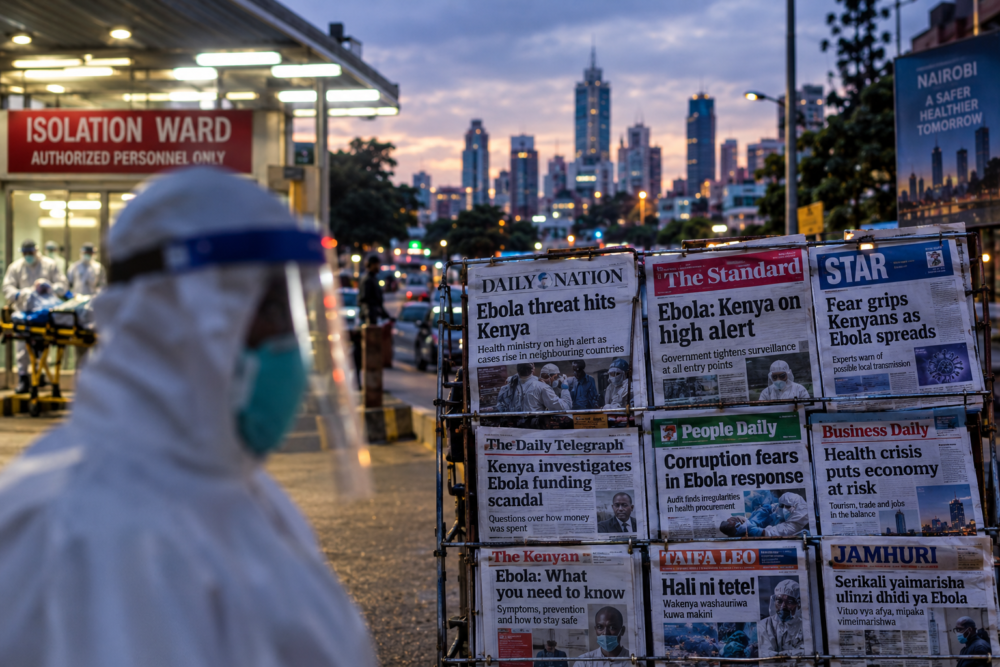
NAIROBI—The containment lines holding back one of the world’s most feared hemorrhagic fevers are currently drawn through the clinical corridors of the Kenyan capital.
On Sunday, October 18, 2026, Kenya’s Ministry of Health confirmed the country’s eighth case of the rare, highly lethal Bundibugyo Ebola virus. While the epidemiological data suggests a contained cluster—all eight infections trace directly back to a single primary index patient—the broader national response has rapidly mutated into a complex geopolitical and domestic political crisis.
As the government struggles to project calm, the outbreak has laid bare a profound national anxiety, exposing fractured trust in public institutions, igniting fury over sovereign defense arrangements, and threatening to isolate East Africa’s economic hub at a critical moment.
The Epidemiological Ledger
The origin of the Kenyan cluster is rooted in the vast, porous borderlands of the Democratic Republic of the Congo (DRC). The index patient, a 40-year-old Kenyan agricultural trader, traveled overland from the DRC, passed through Uganda, and boarded a commercial flight—Jambojet flight #8523—to Nairobi. His family members drove him to the Nairobi Hospital where he was admitted to but soon after succumbed to the disease on October 5.
The scale of the threat he inadvertently imported is staggering. The DRC is currently enduring the deadliest Ebola outbreak in its history; the epidemic has just breached an eighth province (North Ubangi) and has recorded at least 9,400 cases, with over 4,500 fatalities.
The latest Kenyan casualty is a 49-year-old hospital attendant. “Not a direct health care worker, a 49-year-old gentleman who developed symptoms of fever, headache, and muscle pain, and his test came out positive,” confirmed Health Director-General Dr. Patrick Amoth during a Sunday evening interview on Citizen TV. The man, whose duties included cleaning linens and utensils used by the index patient, tested positive while already under quarantine.
The Ministry of Health is deploying a strategy of aggressive containment and targeted therapeutics. The confirmed patients are receiving compassionate care, specifically Monoclonal Antibodies treatment, which Dr. Amoth noted “they have been responding very well” to. Crucially, the Director-General sought to allay rising public panic, emphasizing that the risk of community transmission remains low because the secondary cases were already isolated when they became infectious. “They develop the symptoms much, much later, day nine, day ten,” he explained.
Frontline Fury and the KMPDU Ultimatum
Despite the assurances from Afya House, the medical fraternity on the front lines is livid.
Three of the seven secondary infections are healthcare workers who attended to the index patient at The Nairobi Hospital. Their infections have triggered a fierce backlash from the powerful Kenya Medical Practitioners, Pharmacists and Dentists Union (KMPDU).
The union is demanding immediate answers regarding the breakdown in basic barrier nursing protocols. “And so how did the infection happen?” questioned KMPDU officials in a public statement. “When were the suspicious symptoms on the patient detected? Were all healthcare workers adequately protected? And at what point did full precautions begin?”
The KMPDU is no longer accepting passive assurances from the Ministry. The union has issued an ultimatum, demanding that frontline medical professionals be granted direct, executive inclusion in outbreak planning, hospital readiness audits, and the management of Ebola cases. Furthermore, they are demanding that contact tracing be expanded aggressively to include every single patient those infected medics interacted with before they were placed in isolation.
The Nanyuki Conundrum: A Sovereign Insult
If the clinical missteps have angered the doctors, the geopolitical optics of the containment effort have infuriated the public.
At the center of this controversy is an ultra-modern, biosafety containment facility located within the Laikipia Air Base in Nanyuki. Financed and constructed by the United States, the facility was designed specifically for the medical evacuation and treatment of American personnel operating in the region.
As Kenyan physicians scramble to isolate suspected cases behind makeshift plastic sheeting in under-equipped urban hospitals, the realization that a state-of-the-art facility sits on sovereign Kenyan soil—expressly forbidden to Kenyan citizens—has touched a raw nerve.
The existence of an “American-only” medical enclave during a national emergency has sparked intense local fury, prompting previous halt-orders from Kenyan ministers and fueling widespread resentment. It serves as a stark, physical reminder of the asymmetrical power dynamics governing international health security, leaving the Kenyan government to explain why it leased sovereign land for a facility that offers its own citizens no sanctuary.
The Specter of the “Ebola Millionaires”
Compounding the crisis is a severe, almost paralyzing public cynicism regarding the government’s financial integrity.
Across social media platforms like X (formerly Twitter) and Facebook, the public discourse is dominated not merely by virology, but by corruption [cite: 1, 2]. Local observers and digital commentators are openly expressing fears that the Ebola response budget will be weaponized as a cash-grab for lucrative state tenders.
This skepticism is not unfounded; it is deeply rooted in the traumatic memory of the 2020 COVID-19 pandemic. During that crisis, officials at the Kenya Medical Supplies Authority (KEMSA) and politically connected individuals—dubbed the “COVID Millionaires”—embezzled billions of shillings in donor funding intended for personal protective equipment (PPE), leaving frontline doctors exposed to a deadly virus.
The political opposition has ruthlessly weaponized these fears. In highly publicized press conferences, opposition leaders have accused the current administration of gross negligence in border surveillance, while simultaneously demanding that international development partners, including the United States, implement strict, independent oversight of any funds disbursed for the Ebola threat. They allege that the ruling administration is inherently predisposed to misappropriating emergency funds, effectively transforming a lethal public health crisis into a high-stakes political battleground.
The Regional Quarantine
As the internal political warfare intensifies, the economic threat of regional isolation looms large.
“Kenya remains open, with no restrictions on travel, trade or public gatherings,” Dr. Amoth declared over the weekend. Infectious disease experts, such as Dr. Loice Achieng Ombajo from the University of Nairobi, have taken to the airwaves to warn that “misinformation and propaganda threaten the national response more than the virus itself”.
Currently, there are no blanket international travel bans, and the World Health Organization (WHO) explicitly advises against imposing them. Western nations, including Canada and Australia, have updated their travel portals to advise strict health precautions, while the U.S. Embassy in Nairobi issued a specific Health Alert detailing the index patient’s flight information for passenger awareness .
However, Kenya’s immediate neighbors are taking no chances. In a move that has rattled the East African business community, Tanzania has officially bypassed mild warnings and issued Travel Advisory No. 18. Effective immediately, the directive makes comprehensive health declarations, electronic screening, and a mandatory 21-day automated monitoring protocol compulsory for anyone traveling from or through Kenya. High-risk travelers will be subjected to daily surveillance via automated messages.
While absolute border closures remain unlikely unless community transmission breaches quarantine lines, the biggest fear echoing through Nairobi’s corporate boardrooms is the prospect of a knee-jerk economic isolation by Western markets.
Kenya stands at a precipice. The epidemiological tracing—which international commentators note has been highly effective in tracking 128 out of 130 primary contacts—is the only tangible barrier preventing an absolute disaster in a major African metropolis. Yet, as the virus tests the limits of the country’s medical infrastructure, it is simultaneously auditing the integrity of its political class. The true containment challenge in Nairobi is no longer just a virus; it is the battle to prevent an epidemic of public distrust from tearing the national response apart.