
By the Coursel.Online Political Desk
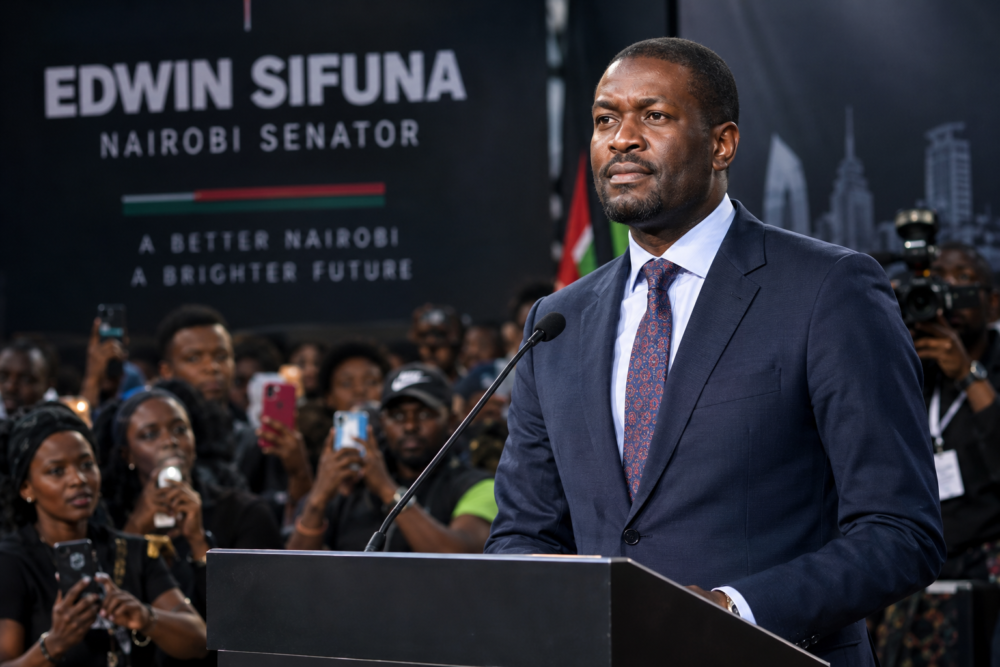
NAIROBI—In the high-stakes theater of Kenyan politics, the line between audacity and political suicide is notoriously thin. For Nairobi Senator Edwin Watenya Sifuna, that line was crossed in early October 2026, when he officially accepted the mantle of The Equitable Party (TEP) and declared his candidacy for the presidency in 2027.
Just days ago, in a sharp exchange that laid bare the generational fault lines of the upcoming election, Sifuna fired a shot across the bow of Prime Cabinet Secretary Musalia Mudavadi, a multi-decade veteran of the establishment. “I will be Kenya’s president before you,” Sifuna declared, brushing off Mudavadi’s warnings that the electorate should not “experiment” with national leadership.
In an era defined by rapid macroeconomic shifts and youthful disillusionment, the question now looms large: Can a presidential novice bypass the traditional ethnic kingpins and capture the highest office in the land?
The Rise of Sifuna
Edwin Sifuna has engineered one of the most abrupt and consequential realignments in recent Kenyan politics. Until July 2026, he served as the powerful Secretary-General of the Orange Democratic Movement (ODM), the traditional anchor of the country’s opposition. However, following a bitter internal fallout that culminated in his ouster, Sifuna did not retreat. Instead, he absorbed the momentum of the grassroots Linda Mwananchi movement, merging it with the formal infrastructure of TEP. His transition from party enforcer to presidential flag-bearer showcases a blend of ruthless ambition and fresh strategic thinking that resonates deeply with a younger electorate exhausted by legacy politics.
Political Background
Born in 1982 in Kakamega County, Sifuna’s political trajectory was built on a conventional, yet rigorous, foundation. Armed with a law degree from the University of Nairobi and a postgraduate diploma from the Kenya School of Law, his entry into the political arena was not merely a career pivot; it was a calibrated response to the frustrations of a millennial generation seeking representation. Winning the Nairobi Senatorial seat in 2022 with over 700,000 votes proved he could command a complex, cosmopolitan voter base. Now, he faces the ultimate test of scaling that urban appeal into a national mandate.
Connecting with the Youth
The arithmetic of Kenyan elections is undergoing a structural shift. With a sweeping majority of the electorate under the age of 35, historical voting blocs are slowly yielding to demographic realities. Sifuna’s core appeal lies in his fluency with this demographic. He articulates the anxieties of the youth—crushing unemployment, stagnant wages, and punitive taxation—with a lawyer’s precision and an activist’s edge. By centering his messaging around Linda Mwananchi (Protect the Citizen), he is actively positioning himself as a voice for the voiceless, transforming raw economic grievance into a viable political currency.
The Importance of Digital Strategy
In a landscape where traditional campaigning techniques require immense capital and legacy media access, a robust digital strategy is the great equalizer. Sifuna operates with a distinct asymmetric advantage on platforms like Twitter (X) and Instagram. His adept use of digital spaces allows him to bypass the traditional media gatekeepers and ethnic power brokers, speaking directly to voters in real-time. This connectivity fosters a sense of immediate community and responsiveness, proving vital in an age where voters demand horizontal engagement rather than top-down political rallies.
Challenges Ahead
Despite his soaring urban popularity and undeniable momentum, the headwinds facing Sifuna are severe. The Kenyan political landscape is effectively an oligopoly, rife with entrenched political cartels that possess immense financial war chests and deeply loyal regional bases. Overcoming this entrenched system requires more than digital charisma. Mudavadi’s recent public dismissal of TEP—questioning its structural viability so close to an election—highlights the institutional skepticism Sifuna must overcome. Running a presidential campaign requires complex logistics, polling agents in every ward, and vast capital reserves.
Building Alliances
To mitigate these structural deficits, collaboration is imperative. Sifuna’s strategic genius thus far has been his ability to splinter the establishment. His October launch drew heavyweights from across the political spectrum, including Siaya Governor James Orengo, Trans Nzoia Governor George Natembeya, and Embakasi East MP Babu Owino. By uniting these disparate regional leaders and young mavericks under a common banner, Sifuna is attempting to present a formidable front capable of bleeding votes from both the ruling coalition and his former ODM allies.
Policies That Resonate
Electoral momentum, however, must eventually crystallize into policy. For Sifuna to solidify his candidacy beyond a protest vote, he must present a governing framework that resonates with the middle class and the corporate sector alike. Focus areas such as sovereign debt restructuring, education reform, and the aggressive eradication of corruption must be at the forefront of the TEP platform. The electorate is demanding a departure from vague populism in favor of executable economic roadmaps.
Job Creation Initiatives
At the core of his economic pitch must be innovative solutions for job creation. As Kenya faces a tightening fiscal space, proposing scalable investments in technology, digital services, and green energy could attract young voters and international capital alike. By highlighting successful, modern economic models—and proving that a younger administration intuitively understands the gig economy and tech sector—Sifuna can inspire confidence in his vision from both the youth and the business community.
The Role of Media and Managing Public Relations
Media perception will play a crucial role in validating Sifuna’s bid. He must navigate both traditional television networks and the decentralized new media landscape to ensure his departure from ODM is framed not as a bitter expulsion, but as a principled graduation. Engaging directly with the press, addressing controversies head-on, and projecting the gravitas of a statesman rather than a provocateur will bolster his credibility. Transparency and institutional accountability must be the thematic anchors of his campaign to build trust among skeptical older voters.
Conclusion: The Future of Leadership
Edwin Watenya Sifuna represents a potential seismic shift in Kenyan politics—the exact point where youthful agitation meets the organized pursuit of executive power. While the traditional political elite may view him as an underfunded upstart experimenting with national leadership, the sheer demographic weight of his base suggests otherwise. As the nation accelerates toward 2027, Sifuna’s turbulent but calculated journey serves as a compelling reminder: in an electorate desperate for economic liberation, a well-organized political novice armed with a vision can indeed aspire to rewrite the rules of the game.