
Unveiling the Complexity Behind Recent European Riots: The Lazy Refugee Narrative and Beyond
By the Coursel.Online Bureau of International Affairs and Economic Policy
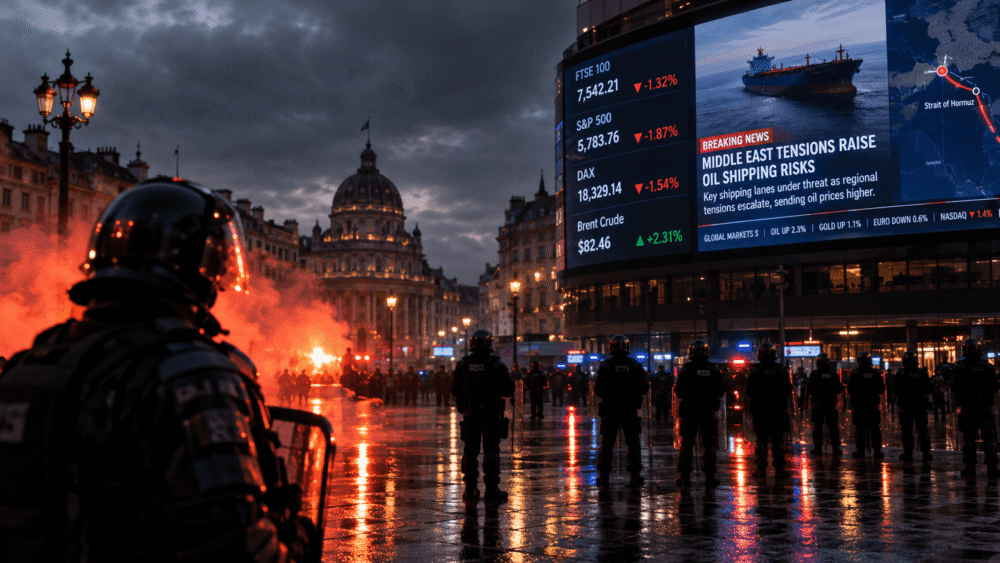
BRUSSELS—The images broadcasting from the capitals of Europe project a continent at war with itself. From the charred storefronts of Paris and the shattered glass in Milan to the persistent, violent anti-immigration clashes echoing across the United Kingdom, a narrative of irreconcilable cultural conflict has gripped the Western world. The prevailing political rhetoric, amplified by a resurgent far-right, offers a dangerously simple diagnosis: an unmanageable influx of Middle Eastern refugees is fracturing the European social contract.
Yet, attributing the widespread civil unrest solely to the presence of asylum seekers is a profound misdiagnosis of a much deeper institutional illness.
The riots tearing through Europe’s urban centers are not the root of the crisis; they are the violent exhaust of a continent buckling under severe macroeconomic stagnation, the shifting dynamics of global trade, and the heavy geopolitical toll of American foreign policy. To understand the true anatomy of Europe’s current unrest, one must look beyond the barricades and examine the complex web of extractive economic legacies, soaring sovereign debt, and imported conflicts that are pushing the European project to its breaking point.
The Economic Tinderbox: Stagnation and the Fraying Social Contract
The most potent accelerant for the current unrest is not cultural, but fiscal. Europe is currently navigating one of its most perilous economic chapters since the sovereign debt crisis.
In 2026, the European Union’s economic growth is projected to languish at a stagnant 1.1%, while traditionally robust engines like Germany barely skirt recessionary territory. France is grappling with a public debt approaching 120% of its GDP, triggering aggressive bond sell-offs and forcing the government into deeply unpopular austerity measures that shrink the fiscal space available to address domestic anxiety.
For decades, the European social bargain rested on an implicit promise: continuous economic expansion would fund robust public services—healthcare, education, and pensions—while guaranteeing a higher standard of living for the next generation. That promise has collapsed. Buffeted by the lingering inflationary shocks of the early 2020s, unpredictable trade tariffs, and the rapid technological displacement of traditional industries, the European middle and working classes are experiencing an acute sense of social demotion.
When public services are underfunded and housing markets become inaccessible, the arrival of new populations inevitably creates a friction point. Refugees and migrants, often housed in economically depressed municipalities, become the highly visible scapegoats for systemic fiscal failures. The anger directed at an asylum seeker in a subsidized housing unit is frequently a misdirected fury at a state that can no longer afford to subsidize its own citizens.
The Reckoning of Extractive Economies
Compounding this domestic stagnation is a quiet but monumental shift in global supply chains. Historically, Europe’s economic prosperity was heavily reliant on an “extractive” relationship with the Global South. The continent imported cheap raw materials, critical minerals, and energy from developing nations in Africa and the Middle East, capturing the lion’s share of the value through advanced manufacturing and intellectual property.
That era is rapidly closing. Resource-rich nations are becoming increasingly assertive, demanding technology transfers, domestic refining capabilities, and vastly improved trade terms in exchange for their commodities. As the Global South leverages its resources to move up the value chain, European manufacturing margins are being squeezed relentlessly.
This economic reckoning places European policymakers in a bind. Unable to rely on cheap external inputs, the cost of living and production within the Eurozone has surged. The resulting industrial contraction has hollowed out working-class employment in the very industrial heartlands where anti-immigrant riots have found their most fervent foot soldiers.
The Burden of American Wars
While the economic foundation cracks, the demographic pressures on Europe’s borders are largely the byproduct of geopolitical decisions made in Washington. Europe’s refugee crisis cannot be decoupled from the long tail of American military interventionism.
The first massive waves of 21st-century displacement were triggered by the US-led invasions of Afghanistan and Iraq, conflicts that destabilized the broader Middle East and sent millions fleeing toward the Mediterranean. Europe, bound by geography, became the default shock absorber for America’s “War on Terror.”
More recently, this dynamic has been violently accelerated by the Trump administration’s aggressive military posture against Iran. The recent US-led strikes and the subsequent regional conflict have triggered a catastrophic destabilization of the Persian Gulf. For Washington, separated from the conflict by an ocean and boasting domestic energy independence, the war is a strategic maneuver. For Europe, it is an immediate existential threat.
The conflict has not only spiked inflation by threatening energy transit through the Strait of Hormuz, but it has also initiated a massive, desperate exodus of Iranian, Afghan, and Iraqi civilians traversing the perilous routes through Turkey and the Balkans. European capitals are effectively being forced to underwrite the humanitarian and social costs of an American foreign policy over which they exercise virtually no control.
The Israeli-Palestinian Spillover
Simultaneously, the enduring and escalating conflict in the Levant has added a highly combustible layer to Europe’s domestic politics. The devastation in Gaza and the broader Israeli-Palestinian conflict have driven thousands of displaced Palestinians to seek asylum in European cities, carrying with them the profound trauma of a generational conflict.
The Israeli angle has polarized European societies in unprecedented ways. Domestic political discourse has been hijacked by the conflict, with European streets transforming into proxy battlegrounds. Pro-Palestinian demonstrations and pro-Israel rallies frequently collide, straining police resources and deepening societal divides.
For the European far-right, this geopolitical spillover is politically highly lucrative. Opportunistic political figures conflate legitimate geopolitical protest with imported extremism, using the visibility of Middle Eastern conflicts on European streets as alleged proof that multiculturalism has failed. This narrative deliberately ignores the historical role of European colonial powers in drawing the borders of the modern Middle East, presenting the continent merely as a passive victim of foreign chaos rather than a historical participant.
Cultural Friction in a Secular Landscape
While economic and geopolitical forces are the primary drivers of the crisis, the genuine challenges of cultural integration cannot be ignored. The reality of rapidly integrating large populations from conservative, heavily religious societies into the fiercely secular, liberal democracies of Western Europe presents profound sociological friction.
Many refugees arriving from the Middle East carry deeply ingrained Islamic traditions regarding gender roles, freedom of expression, and social hierarchy. These values can, and do, clash with the progressive, secular norms established in modern European capitals.
The friction is real, but it is routinely weaponized. Rather than investing in robust, state-sponsored integration programs—language acquisition, civic education, and inter-cultural dialogue—many European governments, constrained by the aforementioned budget deficits, have left integration to chance. The result is the formation of parallel societies and economic ghettoization, where isolated communities become incubators for mutual distrust.
The Digital Accelerant: Misinformation and Social Media
The final, fatal ingredient in this volatile mix is the modern information ecosystem. Social media platforms act as potent accelerants for localized grievances, stripping away nuance and amplifying outrage.
During the UK riots in 2024 and 2025, the initial spark was not a verified fact, but a viral falsehood. Following a tragic local stabbing, digital platforms were flooded with misinformation incorrectly identifying the attacker as a Muslim asylum seeker. High-profile provocateurs and algorithmically driven engagement metrics turned a localized tragedy into a nationwide race riot within hours.
This digital infrastructure rewards simplistic, inflammatory narratives over complex geopolitical analysis. The declaration that “immigrants are destroying the country” travels infinitely faster on a smartphone screen than a nuanced discussion about the European Central Bank’s interest rates, the legacy of the Iraq War, or the collapse of global trade paradigms.
The Path Forward: Beyond the Scapegoat
As the smoke clears from the latest round of European riots, the continent stands at a crossroads. Continuing to view the unrest exclusively through the lens of immigration is a recipe for perpetual instability. The refugee is not the architect of Europe’s economic stagnation; they are merely the most visible symptom of a shifting global order.
For Europe to stabilize, a multi-faceted and radically honest approach is required. Economically, the continent must pivot from its reliance on extractive global models toward genuine internal innovation and productivity, recognizing that the era of cheap external resources is over.
Geopolitically, Europe must assert a more independent foreign policy, decoupling its strategic interests from American military adventurism that disproportionately harms the European mainland. The continent can no longer afford to act as the passive geopolitical custodian for crises engineered in Washington or the Middle East.
Domestically, addressing the cultural divide requires capital investment, not just political rhetoric. Integration is an active, resource-intensive process that demands adequately funded education systems, robust labor market access, and a commitment to civic unity over divisive ethno-nationalism.
The riots currently scarring European cities are a distress signal from a social model operating beyond its capacity. Until European leadership addresses the deep macroeconomic rot and the geopolitical imbalances fueling the displacement, the barricades will continue to burn, and the true culprits of the continent’s decline will remain safely hidden behind the convenient scapegoat of the desperate refugee.