
By the Coursel.Online Bureau of Finance and Public Policy
NAIROBI—In the rarefied air of East African corporate finance, an equity buyback of Sh3 billion (approximately US$23.2 million) is typically a cause for champagne toasts in the boardrooms of Upper Hill. It signals the consolidation of local capital and the triumphant return of domestic ownership.
Yet, the recent agreement by First Assurance Investments Limited to repurchase controlling stakes in two major insurance firms from South Africa’s Absa Group has triggered anything but celebration. Instead, it has inadvertently ripped the lid off one of the most explosive, politically charged corporate disputes in recent Kenyan history.
At the center of the financial labyrinth sits Prime Cabinet Secretary Musalia Mudavadi, a perennial heavyweight in Kenyan politics and the largest backer of the acquiring firm. Alongside him is Lamu Governor Issa Timamy, a fellow director and political ally. What began as an ambitious strategy to reclaim their former insurance empire has rapidly metastasized into a sprawling legal and political quagmire involving a Sh363.4 million internal fraud scandal, the unprecedented criminal prosecution of three of Kenya’s most powerful banking CEOs, and uncomfortable historical echoes of the 1990s Goldenberg affair.
As the 2027 General Election approaches, the transaction is no longer just a matter for the Insurance Regulatory Authority. It is a severe stress test of Kenya’s financial transparency, the independence of its criminal justice system, and the political vulnerability of the Prime Cabinet Secretary.
The Sh3 Billion Buyback: Reclaiming the Crown Jewel
To understand the current crisis, one must trace the corporate lineage of First Assurance. In 2015, the local investors—prominently featuring Mudavadi’s Syndicate Nominees and Exclusive Holding Ltd.—sold a controlling stake in the insurer to Barclays Africa (now Absa Group) for Sh2.2 billion.
A decade later, as Absa executes a strategic retreat from owning underwriting businesses outside South Africa, the original owners are taking their empire back. In August 2026, an agreement was reached for First Assurance Investments Limited to pay an estimated Sh3 billion to acquire Absa’s 63.32% equity in both First Assurance Company Limited and Absa Life Assurance Kenya Limited.
While the transaction signifies a bold consolidation of local financial power, it immediately triggered intense scrutiny regarding capital sourcing. During his parliamentary vetting for the Prime Cabinet Secretary position in October 2022, Mudavadi declared a formidable personal net worth of Sh4.1 billion, encompassing prime real estate, aviation interests, and corporate equities.
However, personal net worth is illiquid. Deploying Sh3 billion in a single corporate acquisition requires significant capital mobilization. While legitimate avenues abound—shareholder cash calls, syndicated commercial debt, or leveraged equity—the precise funding architecture of the Absa buyback remains tightly guarded. In a political environment hyper-sensitive to the wealth accumulation of sitting cabinet members, opacity breeds speculation.
The Sh363 Million Internal Hemorrhage
The questions surrounding the acquisition’s financing might have remained standard business-page fodder were it not for a concurrent, spectacular internal fraud case that has dragged First Assurance Investments into the criminal courts.
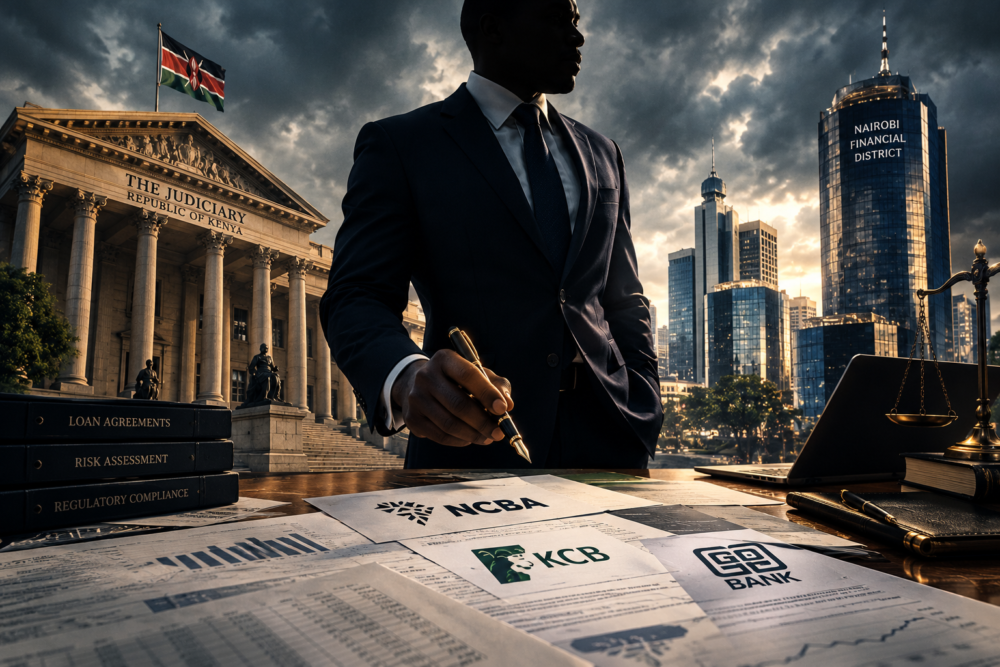
Between May 2018 and April 2024, the company was allegedly hemorrhaging cash. Investigators from the Directorate of Criminal Investigations (DCI) discovered that Sh363.4 million had been systematically siphoned from the firm’s accounts held at three systemic tier-one lenders: NCBA Bank, KCB Bank, and Co-operative Bank.
The prime suspect at the heart of the indictment is former nominated Member of the County Assembly (MCA) Salim Mohamed Busaidy, a former director of the investment firm. According to the charge sheets, Busaidy exploited his access to the firm’s accountants and allegedly forged the signature of Lamu Governor Issa Timamy to execute massive, unauthorized withdrawals, channeling the capital into personal luxury vehicles and real estate.
Busaidy has pleaded not guilty and is out on bond, awaiting trial. But for Mudavadi and Timamy, the discovery of the fraud posed a massive corporate headache. A Sh363 million hole in the balance sheet is catastrophic when the firm is simultaneously attempting to marshal Sh3 billion to buy back Absa’s insurance operations.
To recover the funds, the firm’s principals turned their crosshairs on the custodians of the cash: the banks.
               THE FIRST ASSURANCE FINANCIAL WEB
               =================================

    [ Absa Group (South Africa) ]
                 ▲
                 │ (Selling 63.32% stake for Sh3 Billion)
                 ▼
    [ First Assurance Investments Ltd ] ◄── (Internal Fraud: Sh363.4M siphoned, 2018-2024)
                 │
   ┌─────────────┴─────────────┐
   │                           │
[ Syndicate Nominees ]   [ Exclusive Holding ]
(Musalia Mudavadi)       (Issa Timamy & Partners)
                 │
                 ▼
     THE BANKING DISPUTE
     (Demand for Sh363.4M restitution)
     • NCBA Bank
     • KCB Bank
     • Co-operative Bank
The Ultimatum and the Heavy Hand of the State
What transformed a standard corporate liability dispute into a national scandal was the extraordinary escalation of state power deployed against the commercial banks.
According to investigative reports, representatives of First Assurance Investments issued a rigid 24-hour ultimatum to the three banking giants, demanding full restitution of the Sh363.4 million. The premise of the demand was that the banks’ internal compliance departments demonstrated gross negligence by honoring forged signatures and failing to red-flag years of irregular, high-value withdrawals under the Proceeds of Crime and Anti-Money Laundering Act (POCAMLA).
When the bank executives rebuffed the out-of-court settlement ultimatum—likely preparing for a protracted civil litigation over fiduciary duty and comparative negligence—the full force of the state machinery was abruptly mobilized.
In August 2026, the Office of the Director of Public Prosecutions (DPP) took the unprecedented step of instituting criminal charges against the Chief Executive Officers of NCBA, KCB, and Co-operative Bank. The charge: criminal failure to report suspicious transactions.
This maneuver sent a chilling shockwave through Nairobi’s financial district. The criminal prosecution of sitting CEOs of systemic, publicly traded banks over a disputed corporate client account is highly irregular. The banks immediately moved to the High Court, securing interim injunctions to halt the prosecutions of their top executives, arguing that the state was criminalizing a civil commercial dispute to strong-arm a settlement.
The optics are politically devastating. It projects a narrative where a corporate entity intimately tied to the Prime Cabinet Secretary can leverage the sovereign prosecutorial apparatus of the state to intimidate commercial banks into covering a corporate loss.
“The DPP should provide a clear account of the statutory provisions and evidence relied upon in making the prosecution decisions,” notes a senior financial analyst tracking the case. “When state prosecutors intervene so aggressively in a commercial recovery effort tied to a sitting cabinet minister, it blurs the line between public justice and private debt collection.”
The Ghosts of Goldenberg
For Musalia Mudavadi, the timing and nature of this controversy carry a potent, historical sting.
To understand the political gravity of the current dispute, one must revisit the early 1990s. As Kenya’s Minister for Finance under President Daniel arap Moi, a young Mudavadi found his tenure inextricably linked to the infamous Goldenberg scandal—a labyrinthine export-compensation fraud that looted billions of shillings from the Central Bank of Kenya and nearly collapsed the national economy.
Although subsequent commissions of inquiry cleared Mudavadi of direct criminal complicity—framing him as a minister who inherited the scheme and was manipulated by deeply entrenched state cartels—the shadow of Goldenberg has trailed his political career for three decades. His opponents have routinely resurrected the scandal to question his administrative vigilance.
The parallels between the 1990s and today are purely structural, yet politically undeniable. Once again, Mudavadi’s name is adjacent to missing hundreds of millions, allegations of forged documentation, and the controversial conduct of state financial and prosecutorial institutions. While there is absolutely no evidence suggesting Mudavadi was involved in the Busaidy withdrawals—he is, in fact, the victim of the alleged fraud—his political adversaries are already weaving a narrative of systemic entitlement and institutional impunity.
The 2027 Electoral Calculus
The financial tangle surrounding First Assurance strikes at the heart of Kenya’s looming 2027 General Election.
President William Ruto’s administration is currently struggling to maintain public support amid widespread economic distress, punitive taxation, and youth-led protests demanding institutional accountability. Prime Cabinet Secretary Mudavadi was brought into the executive specifically to project a stabilizing, technocratic gravitas.
Instead, the administration finds its third-highest-ranking official entangled in a dispute that pits him against the nation’s largest financial institutions.
Opponents are sharpening their knives. The opposition will likely frame the DPP’s aggressive pursuit of the bank CEOs as proof of state capture, arguing that ordinary Kenyans face brutal debt-collection tactics from commercial banks, while high-ranking politicians can command the criminal justice system to recover their corporate losses.
If Mudavadi intends to be a viable consensus or a clean running mate in 2027, the optics of “Musaliagate” must be neutralized. Political leaders typically prefer to quarantine their private financial battles far away from election season; Mudavadi currently finds his sprawling across the front pages.
A Demand for Radical Transparency
The unfolding drama surrounding the Sh3 billion Absa buyback and the Sh363.4 million fraud case cannot be dismissed through standard political deflections. It requires radical, documentary transparency.
First, the ownership and financing structure of the Sh3 billion Absa acquisition must be disclosed to the extent required by capital markets and the Insurance Regulatory Authority. Mudavadi must unequivocally distance his public office from his private corporate maneuvers, clarifying whether he or his proxies had any communication with the DPP regarding the bank executives.
Second, the commercial banks must answer to their shareholders and regulators regarding how nearly Sh400 million could be extracted through allegedly forged signatures over six years without triggering internal anti-money laundering alarms.
Finally, the Office of the Director of Public Prosecutions faces an existential credibility test. It must demonstrate to the High Court that charging the banking CEOs was a decision rooted purely in the objective application of POCAMLA statutes, not a punitive favor granted to a powerful political patron.
Kenya’s financial markets rely on the premise that corporate disputes will be settled in boardrooms and civil courts, not through the weaponization of state prosecutors. As the 2027 political drums begin to beat, Musalia Mudavadi’s corporate headache serves as a stark reminder: in the intersection of African wealth and political power, there is no such thing as a private transaction.