A quiet real-estate gambit, an unsettled Arctic, and the transatlantic hedge
When Donald Trump first floated the idea of buying Greenland from the Kingdom of Denmark in the late summer of 2019, the foreign-policy establishment responded with the practiced condescension it reserves for diplomatic breaches of etiquette. Mette Frederiksen, the Danish prime minister, dismissed the gambit as “absurd.” Commentators drew facile comparisons to nineteenth-century imperialism, mocking the transactional presumption that an autonomous territory inhabited by 57,000 citizens could be transferred like a Manhattan hotel property.
Yet geopolitics has a curious habit of turning yesterday’s punchline into tomorrow’s baseline. Seven years on, through a sequence of bilateral defense accords, NATO summits, and resource-access protocols, Washington has achieved by incremental diplomacy what its forty-fifth—and now forty-seventh—president initially demanded by rhetorical bluster. Without a shot fired or a sovereign border formally erased, the United States has successfully locked down comprehensive strategic, military, and economic rights over the world’s largest island.
Simultaneously, a subtler but no less momentous divergence is quietly under way across the 49th parallel. Canada, historically the most docile and economically integrated of American neighbors, has begun a conscious, multi-faceted drift toward Europe. Rattled by recurrent waves of American protectionism, predatory interest in its raw commodities, and cross-border political meddling, Ottawa is rediscovering its transatlantic destiny. The polar map is being redrawn, and the familiar architecture of North American security is fracturing along unfamiliar lines.
The Arctic Real-Estate Gambit Revisited
The transformation of Greenland—Kalaallit Nunaat—from a sleepy Danish overseas territory into the pivot of Western polar strategy is the culmination of decades of strategic anxiety. The notion of an American purchase was never entirely unprecedented; Harry Truman offered Denmark $100m in gold for the island in 1946, recognizing its geography as the natural aerial choke point between North America and the Eurasian landmass. The 1951 defense agreement between Washington and Copenhagen had already established Thule Air Base (now Pituffik Space Base), embedding American radar and early-warning apparatus deep into the permafrost.
What has shifted over the past decade is not the geography, but the thermodynamics. As the polar ice caps retreat under the pressures of climate change, the Arctic is transforming from a frozen wasteland into a navigable maritime corridor and an accessible treasure chest. The Northern Sea Route along Russia’s Siberian coastline and the Northwest Passage winding through Canada’s archipelago are trimming weeks off traditional maritime transit times between European and East Asian markets.
In this newly liquid theater, Greenland commands the North Atlantic approaches and the vital Greenland-Iceland-United Kingdom (GIUK) gap. Whoever controls Greenland’s deepwater fjords and airspace effectively controls the gateway to the Atlantic basin.
The American strategy that emerged from the subsequent negotiations at NATO headquarters did away with the crude rhetoric of cash-for-sovereignty in favor of strategic entrenchment. By framing American military expansion as an indispensable NATO modernization program against Russian revanchism, Washington outmaneuvered Danish resistance. Bilateral defense protocols were expanded to permit the Pentagon near-unrestricted operational latitude: modernized missile-defense batteries, expanded runway capabilities for fifth-generation fighters, and deepwater maritime staging facilities designed to counter Russian submarine patrols emerging from the Kola Peninsula. Denmark retains de jure sovereignty; Washington exercises de facto operational command.
Minerals, Magnets, and Mercantilism
Yet security is only half the equation. The modern scramble for the High North is driven as much by the periodic table as by ballistic trajectory.
Greenland holds some of the world’s most concentrated, unexploited deposits of rare earth elements (REEs)—neodymium, dysprosium, and praseodymium—alongside substantial reserves of uranium, zinc, and iron ore. These minerals are the lifeblood of modern industrial power: the permanent magnets that drive electric-vehicle motors, the guidance systems of precision missiles, and the components of offshore wind turbines. For years, Western policymakers have looked on with rising panic as China consolidated a near-monopoly over the processing and refining of these strategic elements, using export quotas as an instrument of statecraft.
Under the new accords, American capital and state-backed financing mechanisms, including the Export-Import Bank of the United States, have secured preferential development rights over key Greenlandic mining concessions, notably in regions like Kvanefjeld. By tethering Greenland’s extractive sector directly to Western defense supply chains, Washington has effectively fenced off the territory from Chinese state-owned enterprises, which had previously attempted to finance airports and mining infrastructure in Nuuk.
The economic model is classic commercial sphere-of-influence diplomacy: Danish administrative costs are subtly subsidized, Western industrial demand is guaranteed, and Beijing is decisively shut out.
The Silent Inuit Stakeholder
This high-altitude chess match has unfolded over the heads of the people who actually inhabit the territory. Approximately 88% of Greenland’s population are indigenous Kalaallit (Inuit), whose modern political identity has been forged in an ongoing, cautious pursuit of full independence from Copenhagen.
The historical echo is resonant and unsettling. The original European colonizers who charted the Arctic wastes routinely treated the indigenous inhabitants as geographical fixtures rather than political agents. In the mid-twentieth century, the construction of the Thule base involved the forced relocation of the Inughuit community of Uummannaq, an episode that left deep scars in the Greenlandic psyche.
Today, Nuuk’s parliament, the Inatsisartut, finds itself caught in an acute structural dilemma. Complete fiscal independence from Denmark has long depended on generating sovereign revenues through resource extraction. Yet the very mineral wealth that offers economic self-sufficiency has now attracted the overpowering embrace of the American security state.
Local voices, concerned with the preservation of fragile Arctic ecosystems and traditional hunting practices, find themselves marginalized in high-level defense dialogues held in Brussels and Washington. The rhetoric of national self-determination is celebrated in Copenhagen and Nuuk, but the geopolitical reality of the island is being dictated by the strategic imperatives of global superpower competition.
Canada’s Great Transatlantic Hedge
While the United States consolidates its northern flank in Greenland, its relationship with its oldest and most integrated neighbor has entered an unusually frosty chapter.
For nearly a century, Canadian foreign policy rested upon two unshakeable pillars: an automatic security guarantee underwritten by the American nuclear umbrella (formalized through NORAD and NATO), and frictionless access to the vast consumer markets of the American continent. That comfortable consensus is unravelling. Successive American administrations—animated by an aggressive, bipartisan economic nationalism—have demonstrated that the border is no longer an open channel, but a potential choke point.
From punitive tariffs on Canadian softwood lumber and steel to the recurring renegotiation threats surrounding the United States-Mexico-Canada Agreement (USMCA), Ottawa has received an unmistakable message: proximity to Washington is no longer a guarantee of prosperity; it is an exposure to systemic risk.
In response, Canada has embarked upon a deliberate, calculated transatlantic pivot. This is not an emotional rupture, but an institutional hedge.
The centerpiece of this alignment is the Comprehensive Economic and Trade Agreement (CETA) between Canada and the European Union. While American politicians talk of tariffs and reshoring, Ottawa and Brussels have worked to lower non-tariff barriers, integrate green-procurement frameworks, and construct trusted critical-mineral supply chains. European capital is increasingly welcomed in Canadian critical-mineral projects—from lithium deposits in James Bay to nickel and cobalt in Ontario—specifically designed to provide European industrial giants an alternative to both Chinese dominance and American protectionism.
The Alberta Fracture and Continental Pull
This transatlantic reorientation, however, is exposing profound domestic fault lines within the Canadian federation itself. Canada is not a unitary economic actor; it is a sprawling, decentralized collection of regional economies, some of which remain deeply, almost inextricably, tied to the American economic engine.
Nowhere is this tension sharper than in Alberta. The province sits atop the third-largest proven crude oil reserves on earth, alongside vast deposits of potash and petrochemical capacity. For decades, Alberta’s energy sector has chafed against the environmental regulations, carbon-pricing regimes, and pipeline restrictions imposed by federal governments in Ottawa. To a vocal segment of Alberta’s conservative political class, Ottawa’s enthusiasm for European-style decarbonization and regulatory integration looks less like enlightened statecraft and more like an existential threat to the province’s economic lifeblood.
American conservative strategists have observed these internal fractures with keen interest. Sotto voce, discussions of continental energy security routinely envision an Alberta severed from Ottawa’s regulatory orbit, integrating directly into the Gulf Coast refining complex. The nascent, though historically fringe, separatist sentiment in Western Canada is sustained by a very real economic reality: Alberta’s natural market runs north-south, toward the refineries of Texas and the midwestern United States, not east-west toward the ports of the Atlantic.
By pivoting toward Europe, Ottawa risks exacerbating these internal fissures, pitting an internationally minded, trade-diversifying federal core in the east against an extractive, continentalist western periphery.
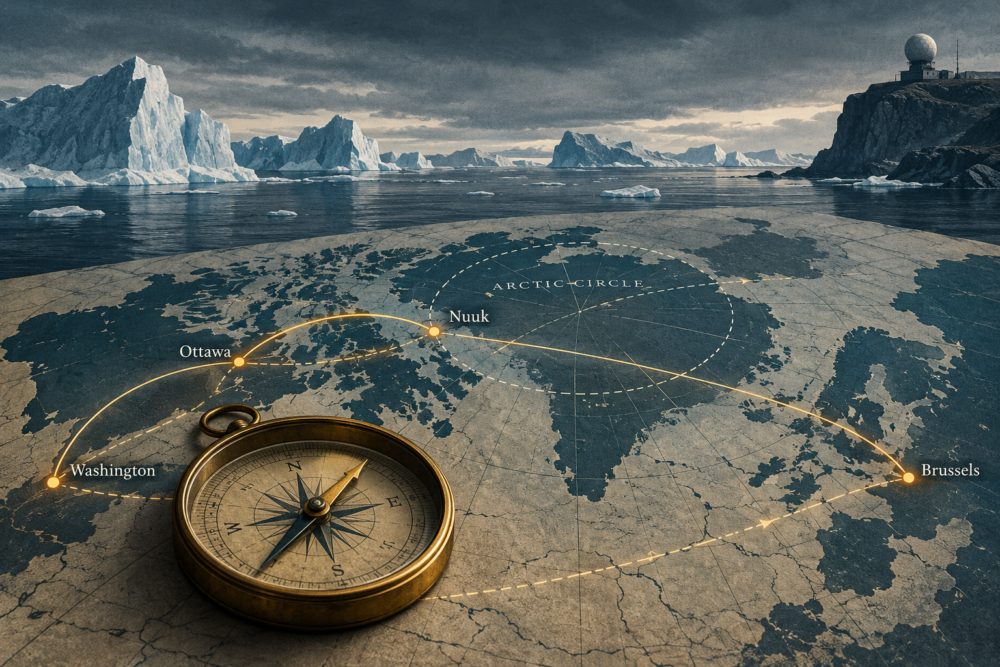
       ARCTIC & TRANSATLANTIC REALIGNMENTS
       ===================================

                [ RUSSIA ]
              (Militarized Bastion,
             Northern Sea Route Patrols)
                       ▲
                       │ Strategic Chokepoints
                       ▼
               [ GREENLAND ]
      (Pituffik Base, Critical Minerals,
          US De Facto Security Zone)
                 ▲           ▲
    Monroe Logic │           │ NATO / Greenland-Iceland-UK Gap
                 ▼           ▼
        [ UNITED STATES ]   [ EUROPEAN UNION / UK ]
              ▲                     ▲
              │ Continental         │ Transatlantic Hedge
              │ Friction            │ (CETA, Critical Minerals,
              ▼                     │  Green Energy Corridors)
          [ CANADA ] ───────────────┘
     (Ottawa: Transatlantic Pivot
      vs. Alberta: Continental Integration)
The Bastion and the Thawing Chokepoints
To understand why Washington and Ottawa are behaving in this manner, one must look at the northern horizon through the eyes of the naval planners in the Pentagon and NATO’s Allied Command Operations.
Under Vladimir Putin, Russia has systematically remilitarized its Arctic shoreline. Cold War-era air bases have been reopened along the Kola Peninsula and Franz Josef Land; Arctic-optimized motorized rifle brigades have been permanently stationed in the High North; and the Northern Fleet’s nuclear-submarine arm has received continuous modernization. Moscow views the Arctic through the prism of its “Bastion” defense concept: an impregnable northern fortress designed to guarantee the survivability of its sea-based nuclear deterrent.
Simultaneously, China has declared itself a “near-Arctic state,” launching nuclear-capable icebreakers and pursuing commercial investments under the aegis of a “Polar Silk Road.”
In this strategic environment, the North American continent can no longer afford the luxury of assuming its northern approaches are protected by impenetrable ice. The Arctic Ocean is becoming a conventional blue-water naval theater. For the United States, securing Greenland is the modern expression of the Monroe Doctrine, extended to the Arctic circle: an absolute refusal to permit rival Eurasian great powers to establish commercial or military outposts within striking distance of the American homeland.
For Canada, the reality is more uncomfortable. Ottawa claims sovereignty over the waters of the Northwest Passage, treating them as internal historic waters. The United States, along with the European Union, maintains that the passage is an international strait, open to transit. As the ice thins and commercial transit increases, Canada finds itself squeezed between an assertive American neighbor that demands operational control over Arctic approaches, and a European partner whose regulatory and trade embrace offers an economic counterweight, but little in the way of Arctic naval firepower.
The Fracturing North American Space
For three-quarters of a century, the political geography of North America was treated by Western strategists as a settled, harmonious redoubt. The continent was perceived as an impregnable island of liberal democracy and economic integration, protected by two oceans, ice to the north, and an unassailable American hegemony.
That era has drawn to a close. The acquisition of sweeping strategic and resource dominance over Greenland by the United States demonstrates that classic, hard-edged sphere-of-influence politics has returned to the Western hemisphere. It is an arrangement built on the cold calculation of resource sovereignty, missile trajectories, and rare-earth supply chains, draped in the polite multilateral verbiage of NATO communiqués.
Yet the unexpected corollary to this American consolidation is the psychological and economic uncoupling of Canada. Faced with an America increasingly willing to use its economic mass to bully allies and command continental resources, Canadian policymakers are concluding that survival requires strategic depth. That depth is not to be found in deeper continental integration, but across the ocean, in the regulatory capitals and export markets of a similarly anxious Europe.
As the ice continues its irreversible retreat, the circumpolar north is emerging not as a serene, remote frontier, but as the crucible of a multipolar world. Washington has staked its claim to the frozen gates of the Atlantic; Greenland remains an anxious, beautiful prize caught between self-determination and superpower defense; and Canada is looking across the water to the Old World, seeking in European alliances a shield against the overbearing embrace of the New.